The $2 Trillion Question: Is Your Travel Tech Ready for What’s Coming?
Introduction
Business travel isn’t just bouncing back – it’s preparing to shatter records.
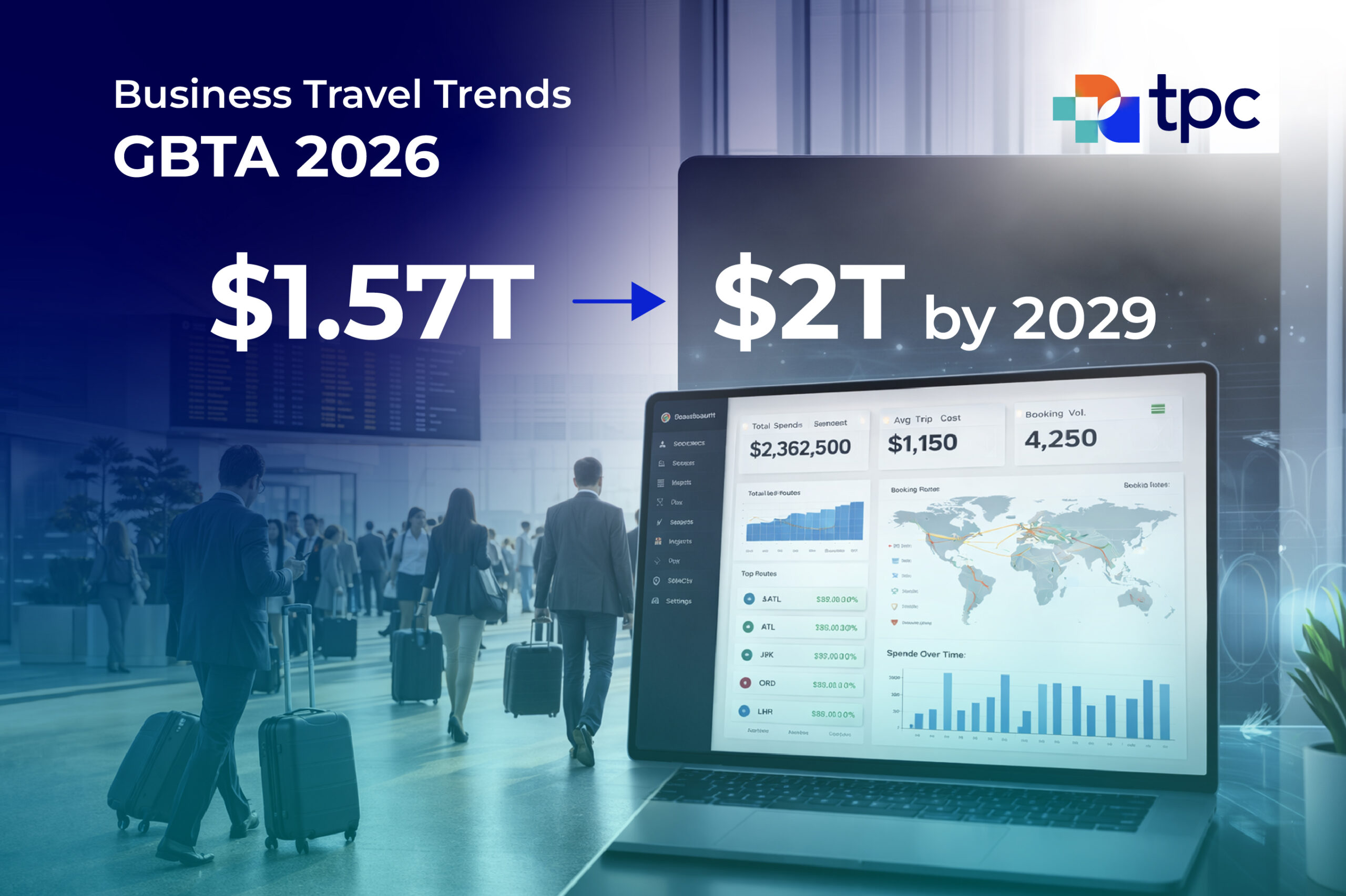
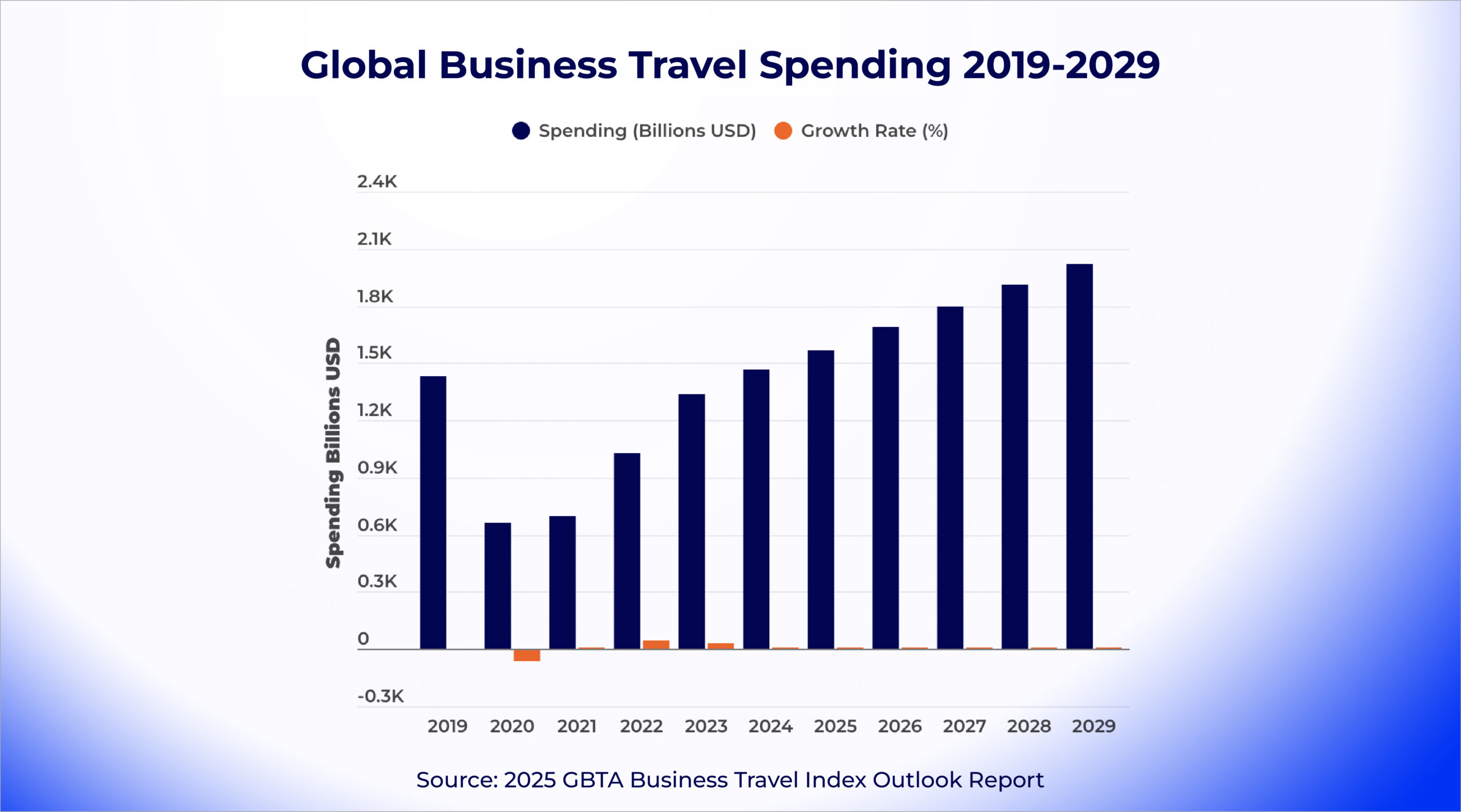
According to fresh data from GBTA 2026, global business travel spending is projected to reach $1.57 trillion in 2025, climbing to $2.02 trillion by 2029. That’s a 28% increase in just four years.
But here’s what the headlines won’t tell you: This growth isn’t just about more travellers getting on more planes. It’s about a fundamental shift in how corporate travel operates – and the technology requirements that come with it.
Let’s unpack what the data really means for travel managers, airlines, and the technology providers serving them.
The Recovery That Became a Boom
The pandemic’s impact on business travel is well-documented – spending plummeted to $661 billion in 2020. But the recovery trajectory tells a more interesting story.
2025: Global spend expected to reach $1.57 trillion
2026: Growth rebounds, with spend hitting $1.69 trillion
2029: Forecast to climb beyond $2 trillion
This isn’t just recovery, it’s acceleration. Companies that learned to operate without business travel are now sending people back on the road, having realized that digital-first doesn’t mean digital-only. Strategic relationships, complex negotiations, and team building still require face-to-face interaction.
The question is: How prepared is the industry for this volume?
Where the Action Is: Regional Powerhouses
While business travel is global, it’s far from evenly distributed.
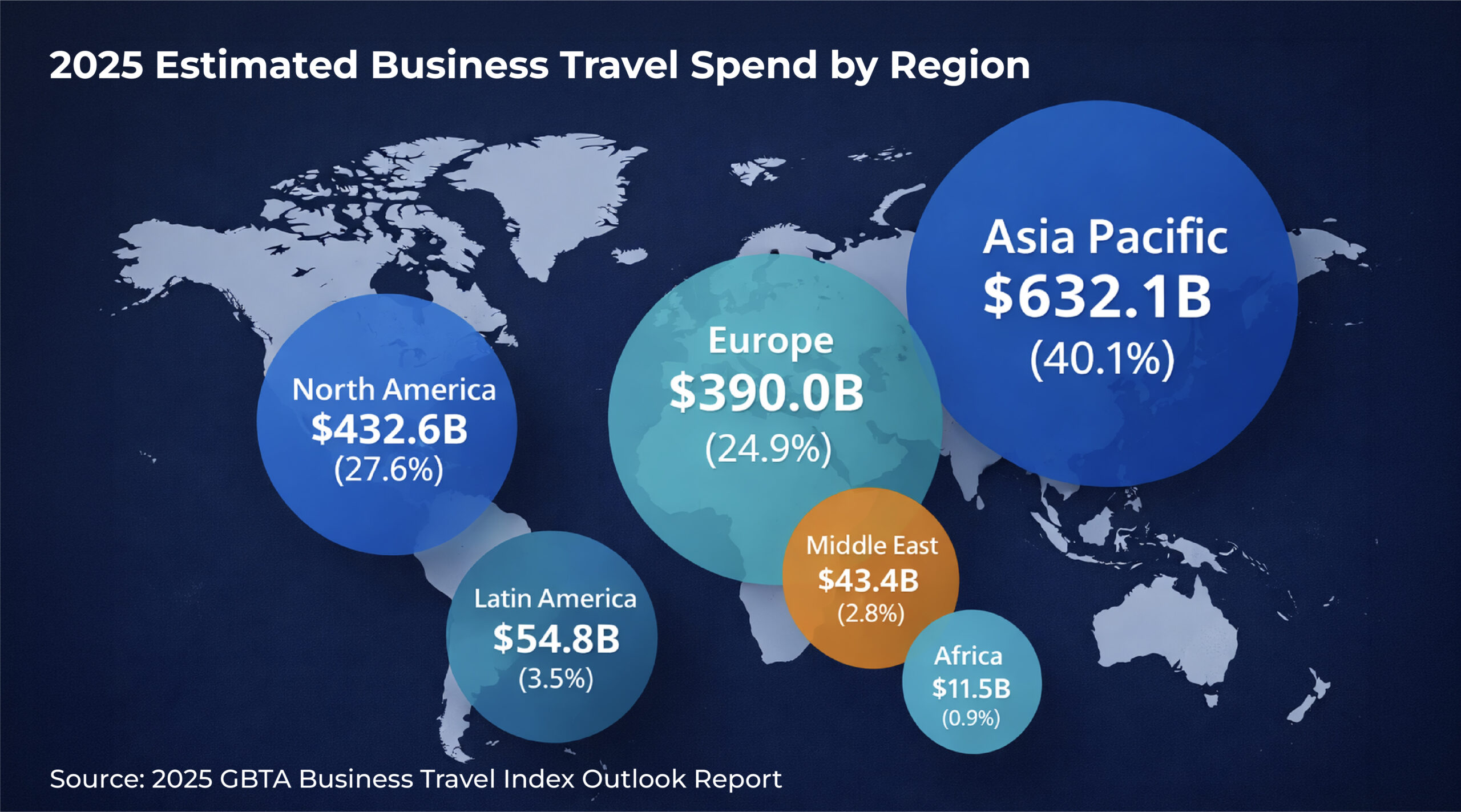
Asia Pacific dominates, commanding 40.1% of global spend at $632.1 billion. This makes sense when you consider the region’s manufacturing hubs, supply chain complexity, and rapidly growing middle class driving both outbound and inbound corporate travel.
North America follows at 27.6% ($432.6 billion), while Europe captures 24.9% ($390 billion).
Together, these three regions account for 92.6% of global business travel spending. For airlines and travel technology providers, this concentration means regional strategies aren’t optional – they’re essential.
But the real story isn’t just about who’s spending the most. It’s about who’s growing the fastest.
The Growth Markets You Need to Watch
Looking at year-over-year growth rates reveals where the momentum is building:
India leads the pack at +15.5%, reflecting its expanding tech sector, manufacturing growth, and increasing integration into global supply chains. With $43 billion in business travel spend, India represents both enormous current value and even greater future potential.
South Korea (+14.3%) and the United Kingdom (+13.9%) round out the top three growth markets. Even mature markets like the United States (+9.6%) are showing strong growth, adding significant volume given their already large base.
Notably, Turkey (+8.9%) is emerging as a connector market – geographically positioned between Europe, Asia, and the Middle East, it’s becoming increasingly important for business travel routing and regional connectivity.
For travel managers, this means:
- Route planning needs to account for new origin-destination pairs
- Supplier negotiations should reflect shifting volume patterns
- Policy flexibility becomes critical across diverse regulatory environments
For airlines and technology providers, these growth markets represent opportunities to establish partnerships before competitors do.
The Concentration Challenge
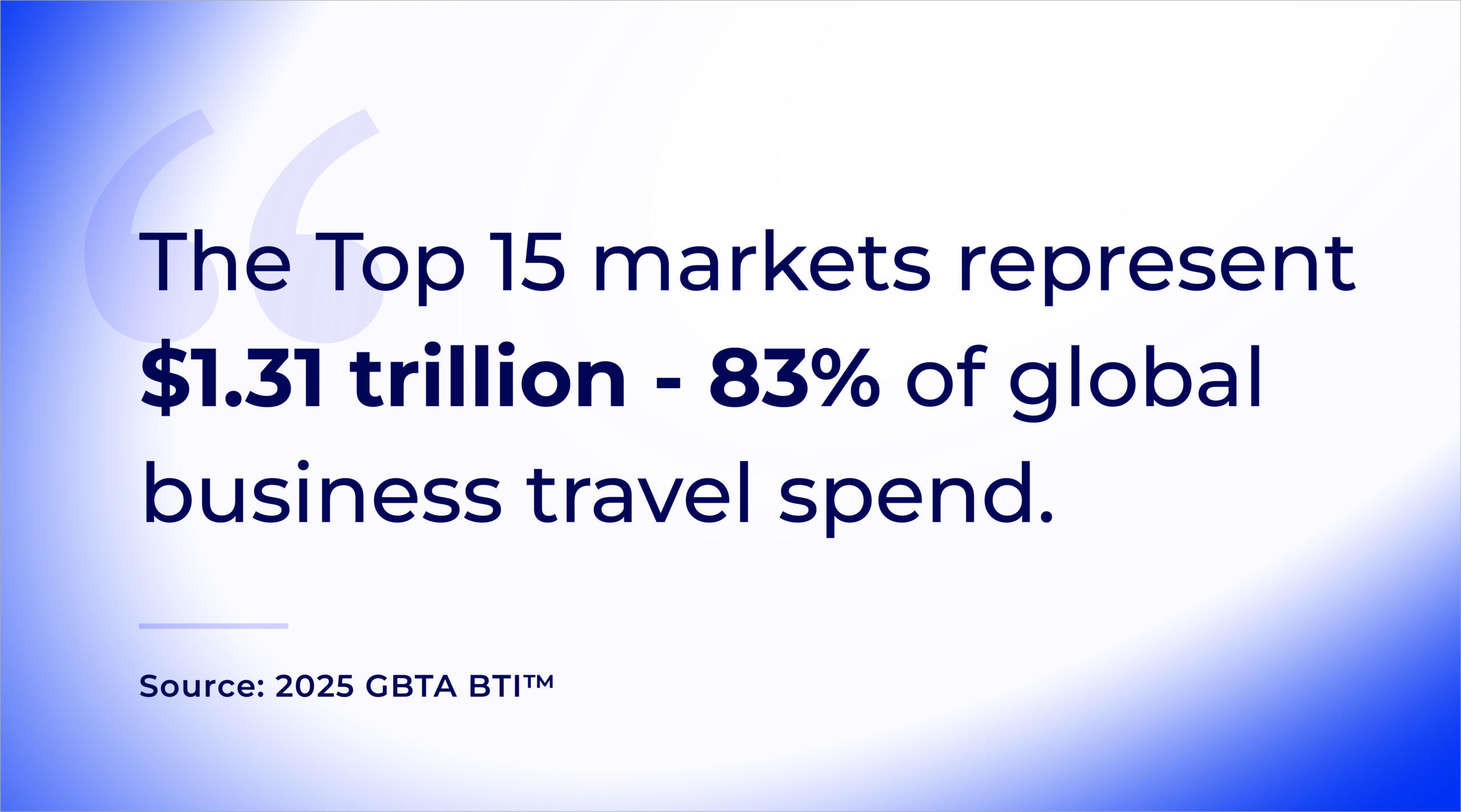
Here’s a striking data point: The top 15 markets alone account for $1.31 trillion – 83% of total global spend.
This concentration creates both opportunity and risk:
Opportunity: Focus your technology, partnerships, and service delivery where the volume actually exists.
Risk: Economic disruption, regulatory changes, or geopolitical issues in these key markets can have outsized impact on global business travel.
It also means that “global” travel programs aren’t truly global—they’re multi-regional programs that need deep expertise in specific high-value markets rather than shallow coverage everywhere.
The Price Reality: Costs Are Climbing (But Not Evenly)
More travelers mean more demand. More demand means upward price pressure. The 2026 pricing forecast shows costs rising across all major categories:
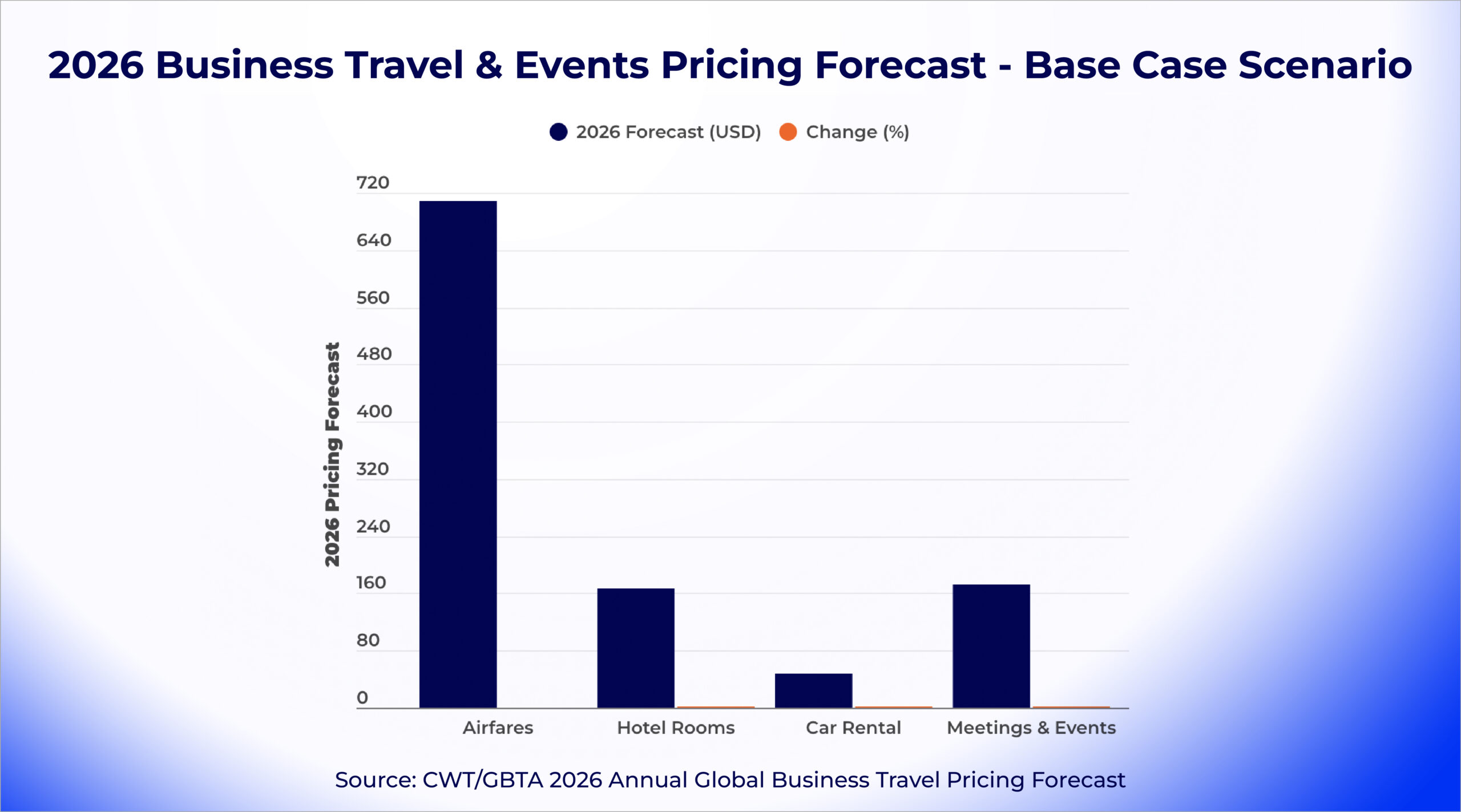
Airfares: Expected to reach $708 (+0.4% from base case)
Hotel rooms: $166 (+1.8%)
Car rentals: $48 (+2.8%)
Meetings & events: $172 per attendee (+2.4%)
While these increases appear modest, they compound over time and across large travel programs. A company spending $10 million annually on business travel could see an additional $150,000-200,000 in costs from price increases alone—before accounting for volume growth.
It’s worth noting that airfares show the most stability, with only 0.4% projected increase. This likely reflects:
- Increased airline capacity coming online
- Competition from new routes and carriers
- Fuel price stabilization
- Airlines focusing on load factor optimization rather than pure price increases
Meetings and events show the steepest increases (+2.4%), possibly reflecting venue supply constraints and increased demand for in-person gatherings post-pandemic.

What This All Means for Travel Programs
Let’s connect the dots.
More volume + Higher prices + Greater complexity = An entirely different ballgame
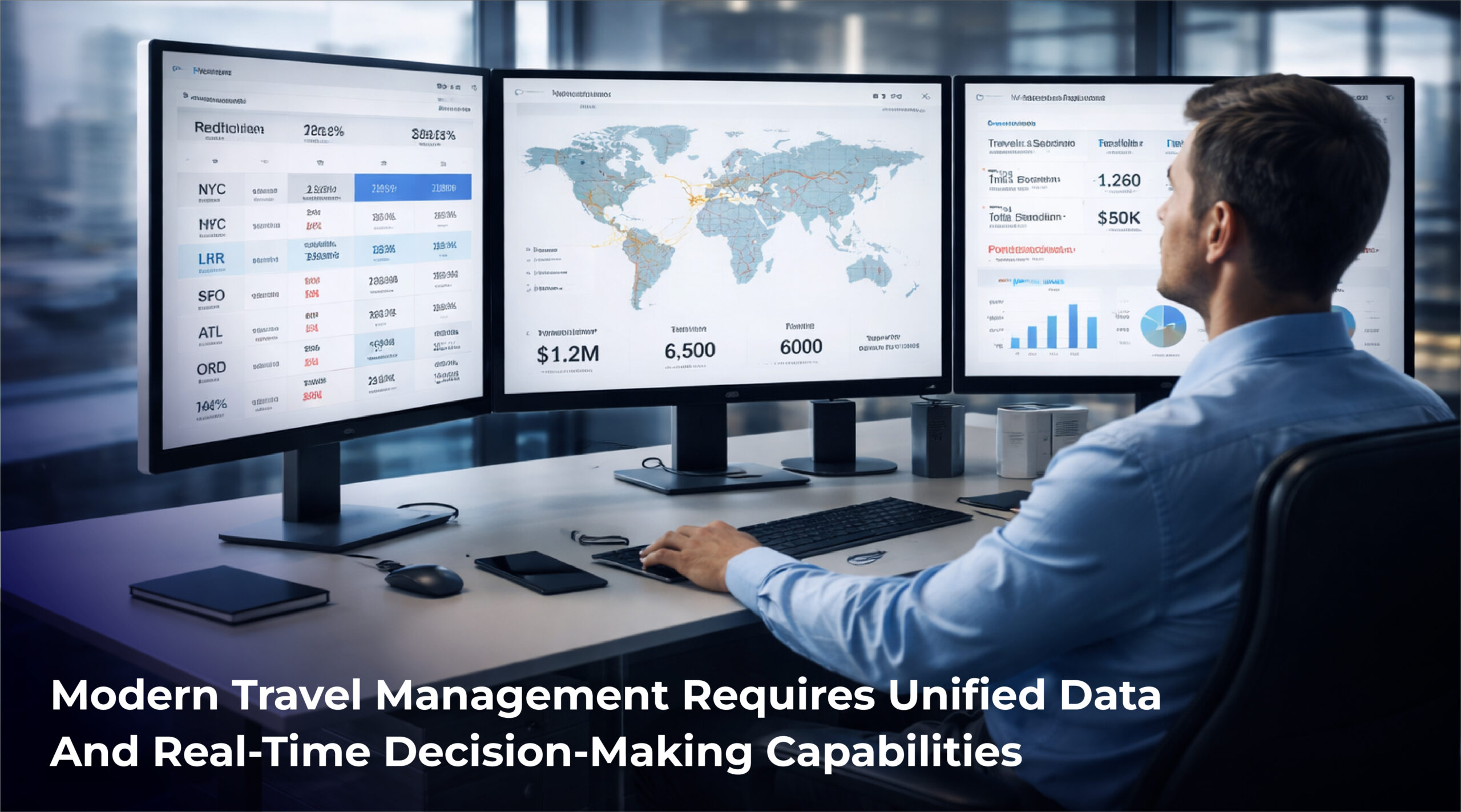
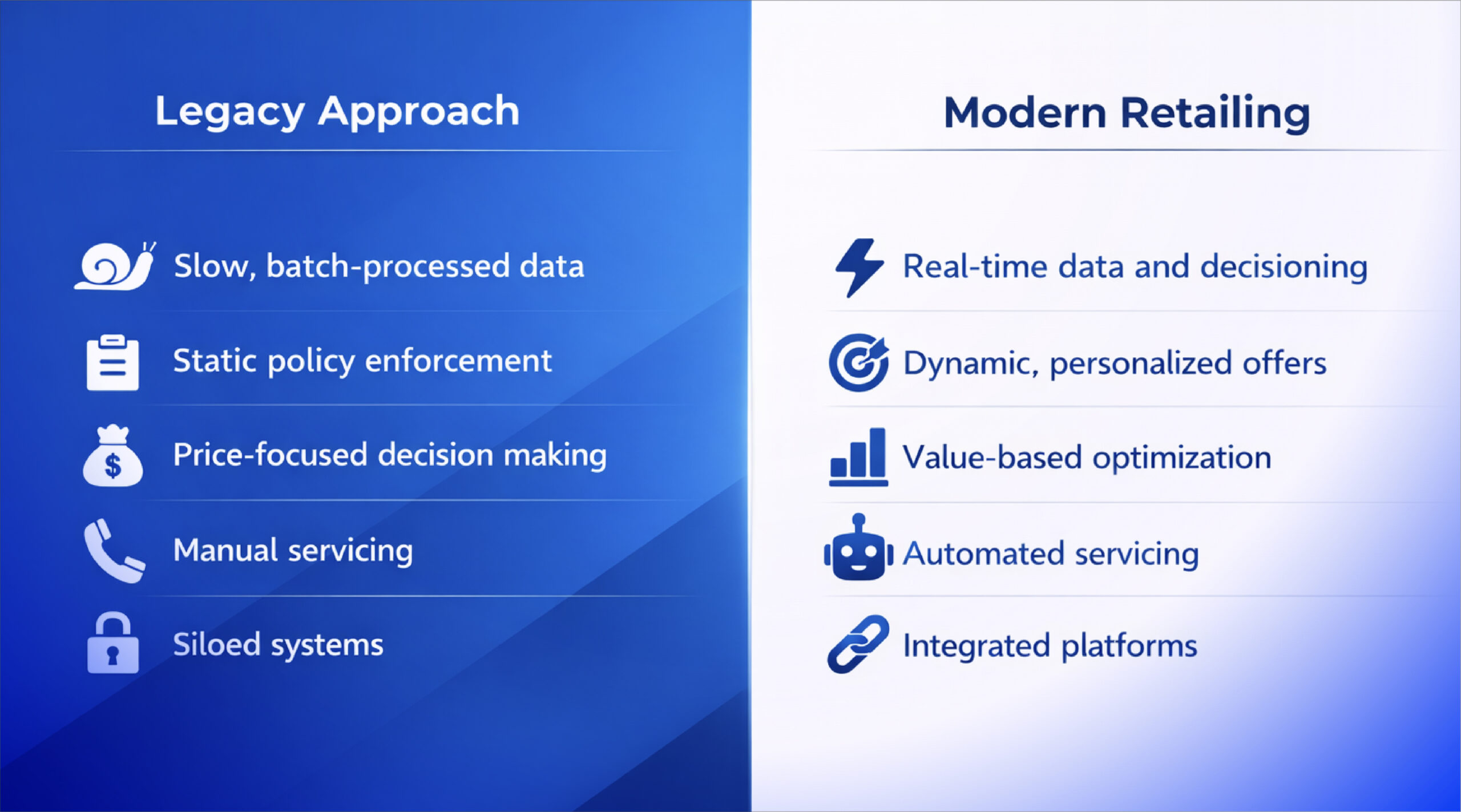
Legacy travel technology wasn’t built for this future.
Traditional legacy systems, rigid booking tools, and disconnected TMC platforms were designed for a different era – one where business travel was predictable, prices were stable, and “good enough” service was acceptable.
But when you’re managing:
- Billions in spending across diverse regions
- Rapidly shifting demand patterns
- Rising costs that compound annually
- Traveller expectations shaped by consumer digital experiences
…you need modern air retailing infrastructure.
What Modern Air Retailing Looks Like
- Offer and Order Management: Move beyond ticket-centric thinking to rich, dynamic offer management that can present, compare, and fulfill complex travel products in real-time.
- Personalization at Scale: Leverage traveller profiles, historical behavior, and preferences to serve relevant options – not just the cheapest or most compliant.
- Dynamic Pricing Intelligence: Understand not just what’s available, but what’s likely to be available, at what price, based on predictive analytics and market intelligence.
- Omnichannel Consistency: Whether a traveller books through a TMC, directly, via mobile, or through a virtual assistant, the experience, data, and compliance framework remain consistent.
- Real-Time Servicing: When disruptions happen – and with more volume, they’ll happen more often – modern platforms enable immediate rebooking, refunding, and communication without manual intervention.
The Strategic Questions You Should Be Asking
If you’re a travel manager, ask yourself:
- Can my current technology handle 30% more volume without adding headcount?
- Do I have real-time visibility into spending patterns and policy compliance?
- Can I personalize offers to travelers while maintaining duty of care?
- How quickly can I adapt policies and programs to new markets or requirements?
- Am I making decisions based on current data or last quarter’s reports?
If you’re an airline or travel supplier, consider:
- Can we retail our products with the richness and personalization travelers expect?
- Are we integrated into the booking flows where corporate travelers actually make decisions?
- Can we differentiate our offers beyond price in a meaningful, scalable way?
- How are we partnering with TMCs and technology providers to reduce friction?
- Are we ready for NDC and modern retailing standards?
If you’re a technology provider or considering one, evaluate:
- Is the platform cloud-native and built to scale?
- Does it support modern retailing standards (NDC, ONE Order, Offer/Order)?
- Can it integrate with our existing tech stack without massive customization?
- Does it provide real-time data and analytics, not just reporting?
- What’s the total cost of ownership – not just licensing, but implementation and maintenance?
Conclusion: The $2 Trillion Question
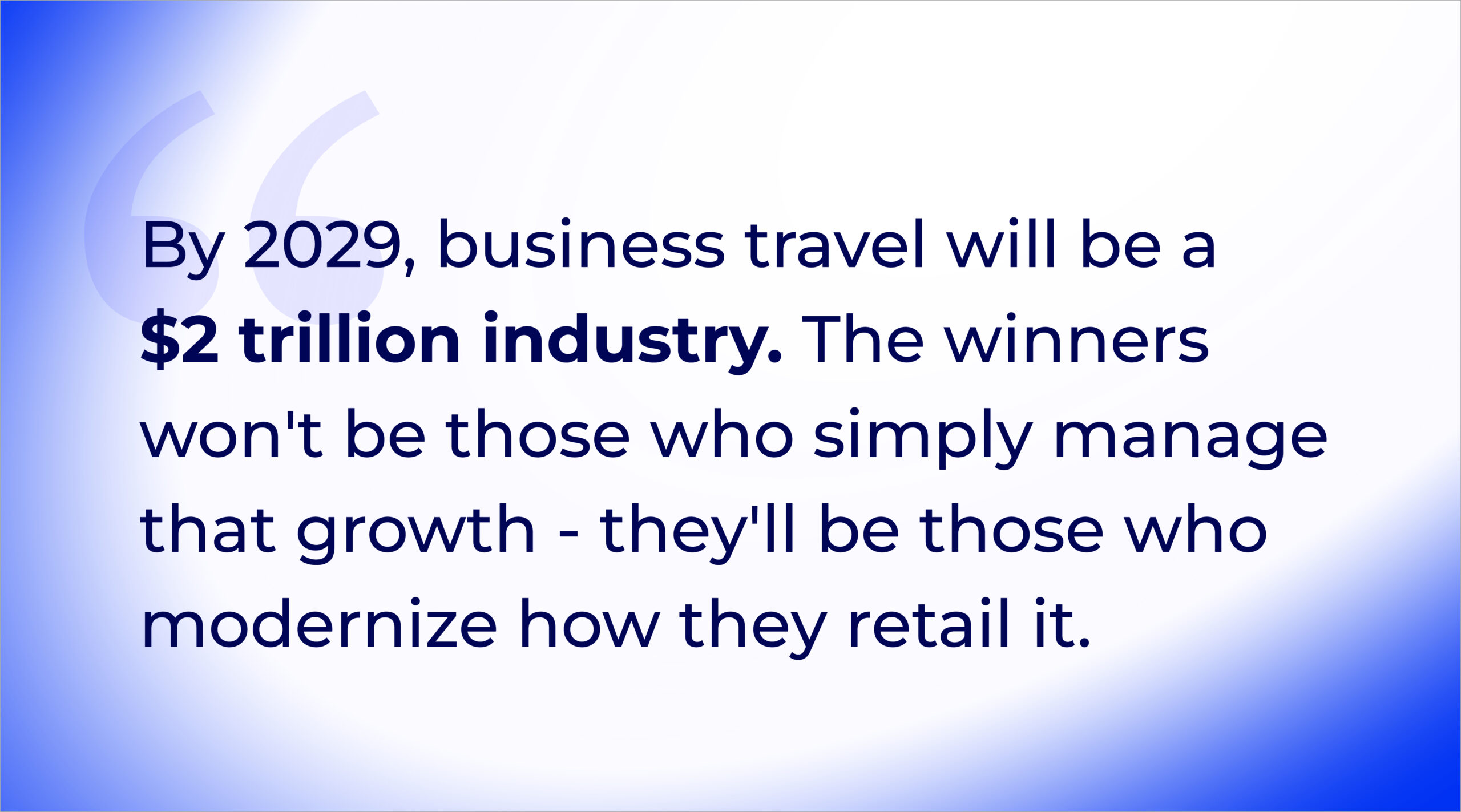
Business travel is entering its most dynamic period in decades. $1.57 trillion in 2025. $2 trillion by 2029. Double-digit growth in key markets. Rising prices across all categories.
This isn’t a challenge to manage. It’s an opportunity to modernize.
The travel programs, airlines, and technology providers who will win in this environment aren’t just preparing for more of the same—they’re fundamentally rethinking how travel is retailed, managed, and experienced.
They’re investing in:
- Modern platforms that can scale without breaking
- Real-time data that enables better decisions
- Personalization engines that respect traveler preferences while maintaining compliance
- Integrated ecosystems that reduce friction and improve experience
- Partnership models that align incentives and share value
The question isn’t whether business travel will grow. The data says it will.
The question is: How ready is your technology stack for what’s coming?
Ready to Modernize Your Air Retailing Infrastructure?
Learn how TPConnects helps travel managers, airlines, and enterprises prepare for the next era of business travel with modern retailing technology built for scale, personalization, and real-time decision-making.
Looking to position your business ahead of these trends? Explore Partnerships with TPConnects.
_____________
About the Data
This analysis is based on data from:
- 2025 GBTA Business Travel Index Outlook Report
- 2025 GBTA BTI™
- CWT/GBTA 2026 Annual Global Business Travel Pricing Forecast
Presented at GBTA 2026 Dubai