Why African Airlines Can’t Afford to Wait on Distribution Transformation
When African airlines are earning just $1.40 profit per passenger while managing distribution costs that eat significantly into already thin margins, the question isn’t whether to modernize – it’s about the imperative to start.
That was the central message from a recent webinar hosted by the African Airlines Association (AFRAA) in partnership with TPConnects, which brought together 37 African airlines – from CEOs to revenue managers – to explore practical pathways towards modern airline retailing.
The Current Reality: Africa’s Distribution Gap
The webinar opened with key context: African airlines carried 113 million passengers in 2025, a 15.3% increase from the previous year, with passenger revenues growing year-on-year. Yet net profit per passenger remains drastically below the global average.
Distribution costs are a key part of that gap. High GDS dependency and limited NDC adoption leave African airlines at a competitive and financial disadvantage.
The stakes are high. Africa’s travel market is forecast to grow at 5% annually through 2034, reaching nearly $40 billion. The question facing African carriers: who will capture that value?
The Customer Expectation Evolution
Kristian van Dijken, VP of Airline Account Management at TPConnects, framed the transformation through the lens of evolving customer expectations:
Past: A seat on a plane, priced by load factor.
Recent: Bundle options – base fare, seat selection, limited change flexibility.
Today: Personalized anticipation of needs. “The customer expects you to know they may need a visa, extra time before payment, Wi-Fi but not a meal – and ideally, they want to arrange all this conversationally through a chat interface, not through multiple screens.”
This shift in customer behavior demands corresponding changes in airline capabilities: product strategy, distribution strategy, and the underlying technology to support both.
Where African Airlines Stand Today
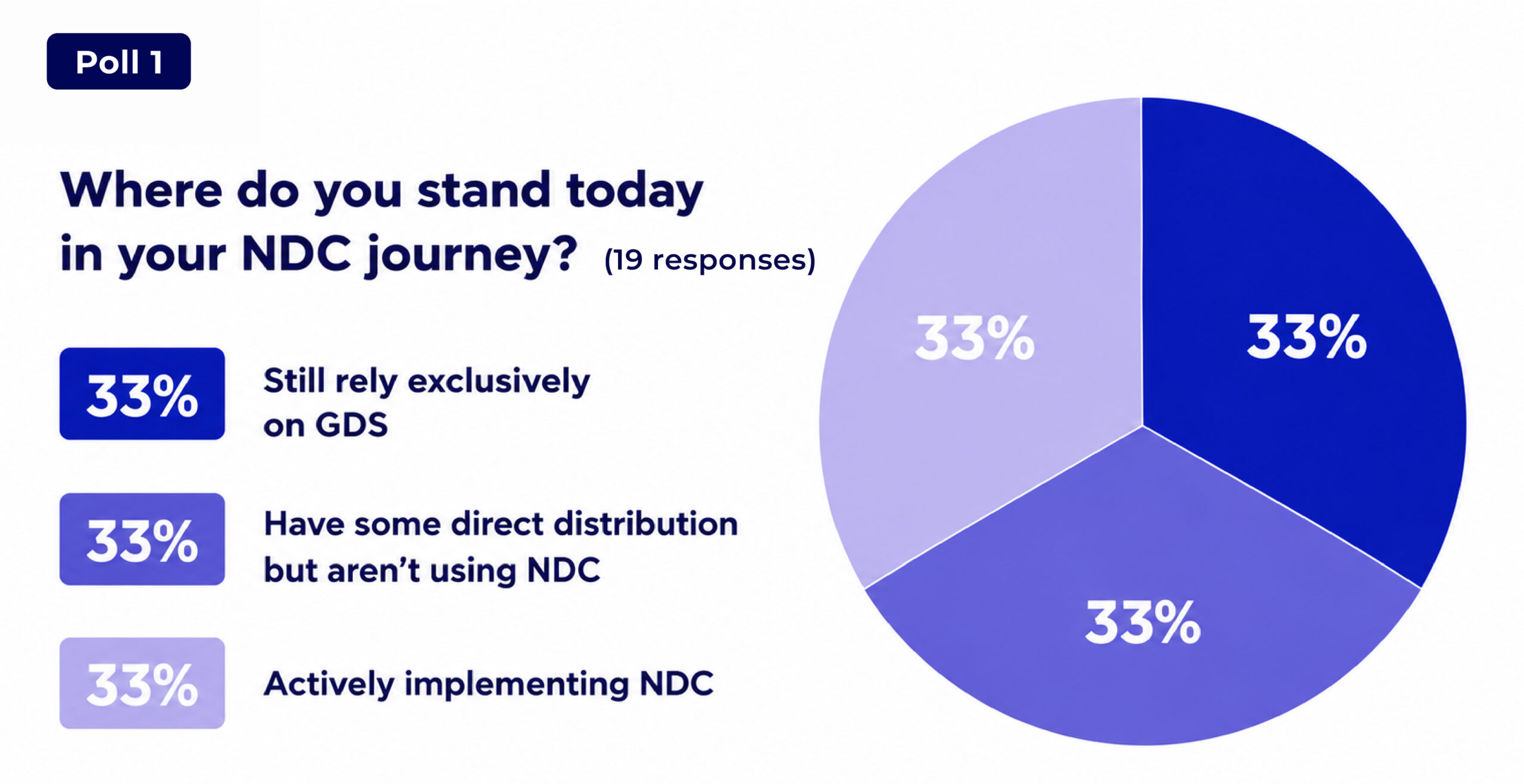
A live poll during the webinar revealed the current state of distribution among participating airlines:
- One-third still rely exclusively on GDS
- One-third have some direct distribution but aren’t using NDC
- One-third are actively implementing NDC
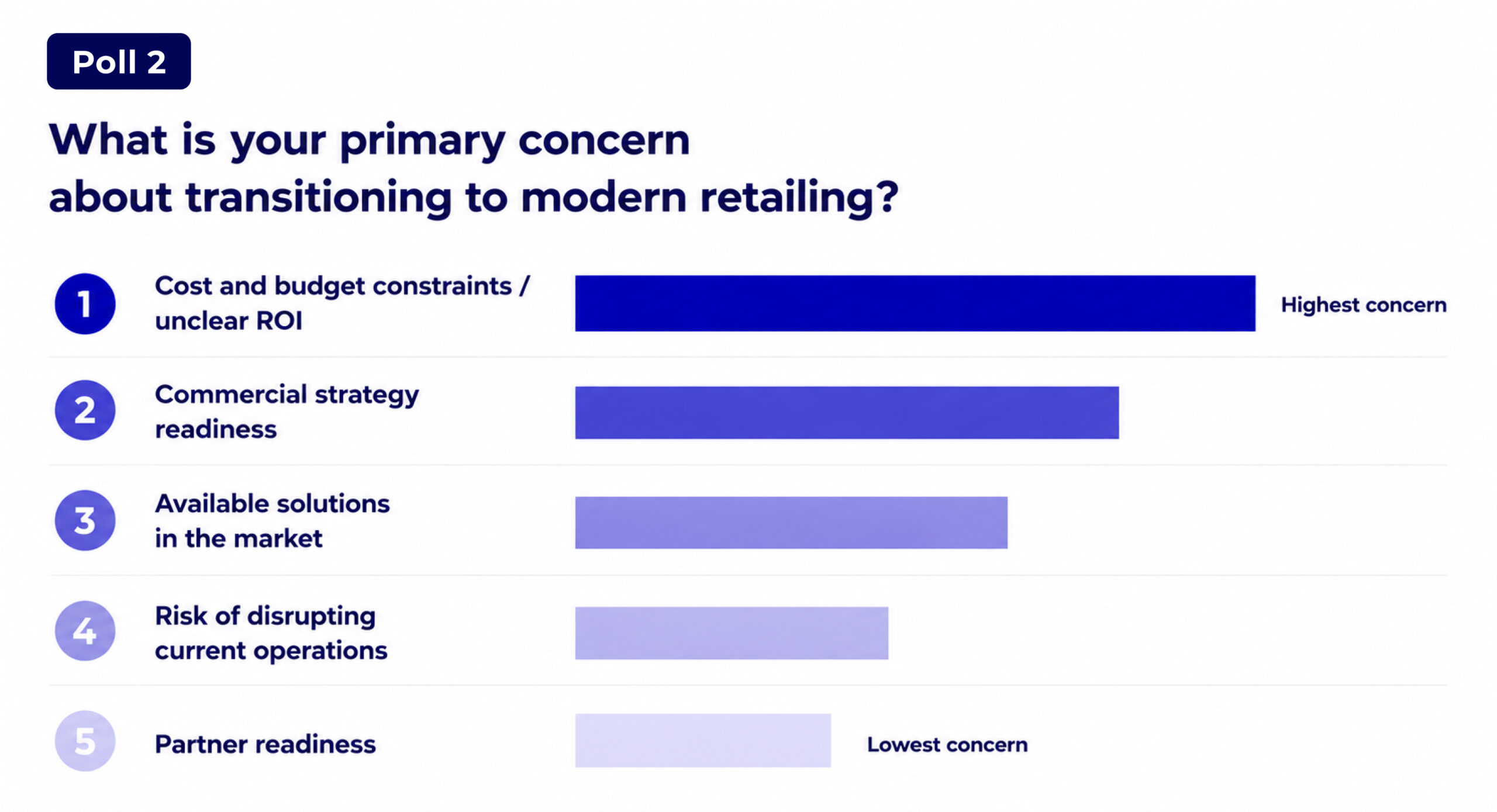
Another poll identified the primary concerns about transitioning to modern retailing:
- Cost and budget constraints/unclear ROI (greatest concern)
- Commercial strategy readiness
- Available solutions in the market
- Risk of disrupting current operations
- Partner readiness
Globally, over 80 airlines currently use NDC, with approximately 25% of traffic flowing through NDC channels. Among AFRAA member airlines, about 30% reported being NDC-capable or in implementation – meaning 70% are either still planning or have not yet started.
NDC: The Foundation, Not the Destination
Giuseppe Candela, VP Global Sales at TPConnects, emphasized that NDC shouldn’t be seen as the end goal – it’s the foundation for modern airline retailing.
“NDC is an API technology standard that enables direct airline-to-agency relationships and gives you commercial freedom to engage with your trade market. But it should not be seen as technology only for large airlines. The technology is mature, vendors are scalable, and it can be adopted by airlines of any size.”
Key NDC benefits include:
- Distribution cost reductions of over 80%
- Richer product distribution, including rich media, bundling, and even non-air products
- Enhanced market reach through expanded distribution channels
Beyond NDC: The Offer and Order Transformation
While NDC provides the distribution foundation, the Offer and Order (OOSD) transformation represents the next evolution in airline retailing.
Today’s systems rely on PNRs, tickets, and EMDs – a transactional, product-centric approach with significant limitations. For example, bookings with more than nine passengers automatically become “group bookings” requiring entirely different processes, even when it’s simply a group of friends travelling together.
The Offer and Order model shifts to a passenger-centric approach with these building blocks:
- Product Catalog: Defines everything the airline retails – air, ancillaries, bundles, and non-air products like eVisas, eSIMs, insurance, hotels, and car rentals
- Stock Keeper: Manages real-time stock
- Offer Management: Creates personalized, dynamically priced offers based on passenger context
- Order Management: Single source of truth for all commercial operations
- Order Settlement and Delivery: Payment collection and service fulfillment
This architecture enables airlines to quickly conceive, define, and launch new products – potentially within hours rather than months.
The TPConnects Astra Solution: Phased Transition Without Disruption
Addressing concerns about operational disruption – a top concern from the polls – TPConnects outlined a staged transition approach through their Astra platform.
Astra NDC provides the foundation:
- API gateway (IATA-certified for NDC 24.4)
- B2B portal for sellers
- MCP (Model Context Protocol) layer for AI chatbot connections
- ConvertEngine to manage look-to-book ratios and reduce unnecessary hits
Astra Nova adds the Offer and Order ecosystem:
- Product Catalog
- Stock Keeper
- Offer Management
- Order Management replacing traditional PNR/ticket/EMD records
The recommended transition path for a mid-sized African airline follows these stages:
Stage 1: Implement NDC while maintaining existing PSS and channels
Stage 2: Run Astra Nova Product Catalog and Stock Keeper in “shadow mode” alongside existing systems, ensuring inventory accuracy
Stage 3: Add Offer and Order creation in shadow mode, syncing with order accounting and service delivery for verification
Stage 4: Begin rolling out by channel or market, with Order Management orchestrating the full process
Stage 5: Traditional PSS ecosystem can eventually be retired (but only when ready)
“These stages can be as long or as short as relevant for you. This is not one-size-fits-all, but these stages help you avoid risk while maintaining control.” Kristiaan van Dijken emphasized.
What’s Driving the Change?
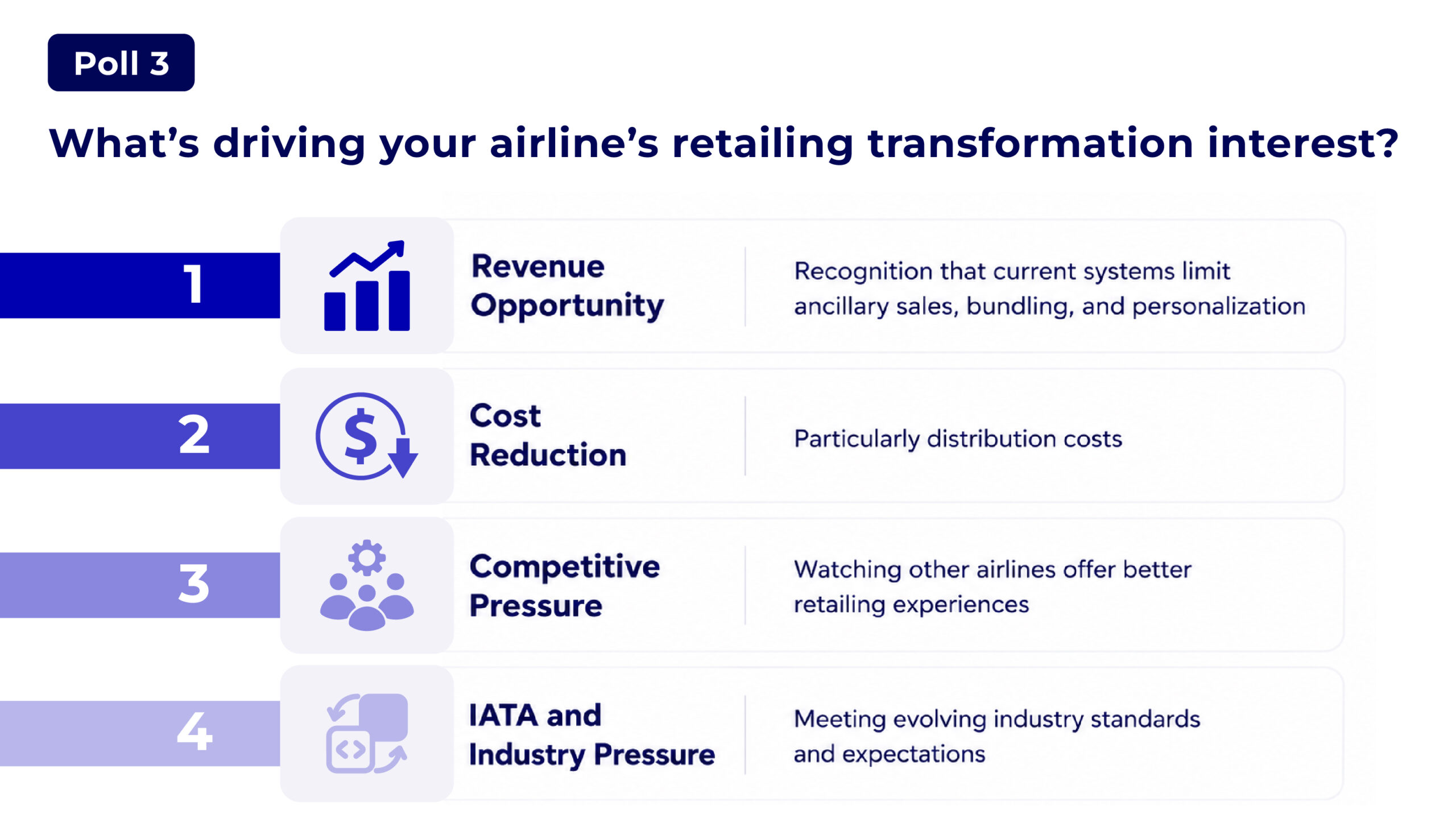
The fact that revenue opportunity topped the list is encouraging – it suggests African airlines see transformation as a growth strategy, not just a cost-cutting exercise.
Success Factors for Transformation
The webinar concluded with critical success factors for African airlines embarking on this journey:
- Vision and Sponsorship: This isn’t just a system change – it’s organizational transformation. Management sponsorship is essential. The language of the business changes from “tickets and EMDs” to revenue-centric terminology.
- Phased Approach: Start small – perhaps with NDC in just a few markets or with select trade partners- then scale progressively based on results.
- Partner Selection and Modularity: Modern retailing allows for best-of-breed selection: offer and order management from one vendor, order accounting from another, offer optimization from a third. Cherry-pick what works best for your airline.
- Change Management: Business readiness must accompany technical implementation. Upskill teams on understanding the product proposition and commercial possibilities, which is often more critical than technical training.
- Measurement: Establish clear transformation KPIs from the outset – tracking both technical metrics and business outcomes.
- Monitoring: Regular monitoring ensures the transformation stays on track and delivers expected returns.
The African Opportunity: Leapfrogging Legacy Constraints
African airlines have a unique opportunity to leapfrog legacy system constraints and implement modern solutions from the outset.
This represents a key advantage of coming later to modernization – African carriers aren’t as burdened by legacy infrastructure as established carriers in other regions. They can adopt best-of-breed, modular solutions from day one.
However, the window for this advantage is closing. The change is no longer optional – it is in motion. Offer and Order will be next. African airlines should catch up on ancillary revenue opportunities and modern distribution.
Taking the Next Step
For African airlines ready to begin their journey, the webinar offered practical next steps:
- Assess current state honestly – where do you fall in the GDS-only / direct-but-not-NDC / NDC-implementing spectrum?
- Identify the primary driver – is it revenue, cost, competitive pressure, or regulatory?
- Start with vision – secure management sponsorship before diving into vendor selection
- Choose modular partners – look for vendors offering phased approaches for stable and safe transition
- Begin with NDC – it’s the foundation for everything that follows
The African airline industry stands at an inflexion point. With the continent’s travel market growing and customer expectations evolving rapidly, the airlines that move decisively towards modern retailing will capture value in the years ahead.
The technology is mature. The business case is clear. Delaying distribution and retailing modernization is no longer a viable strategy for African airlines seeking higher profitability.
Ready to explore how your airline can reduce distribution costs by 80% while unlocking new revenue streams?
Contact TPConnects at sales@tpconnects.com or book an Astra demo.