How Travel Agencies Can Unlock Revenue Through Smarter Pricing Strategies and Automation
With thousands of daily searches across markets, carriers, and fare types, maintaining the right price at the right time has become more complex than ever.
For OTAs, TMCs, consolidators, and B2B travel sellers, pricing has never been more competitive or more complicated. Airlines update fares constantly, customer expectations shift by market, and margins are tight. Yet full real-time dynamic pricing is not always feasible, affordable, or even necessary.
Yet despite the complexity, many agencies still rely on manual updates or fixed markups that don’t reflect real market conditions. The result? Missed commercial opportunities, inconsistent margins, and weakened competitiveness on key routes.
This is exactly where a modern, flexible pricing engine can transform the way travel agencies grow and manage their business.
A pricing engine gives travel sellers the power to shape pricing intentionally, by market, season, product, or customer segment, without depending on static spreadsheets or manual adjustments. And while it’s different from full dynamic pricing, it delivers meaningful revenue uplift today.
Why Pricing Is a Strategic Priority for Travel Sellers
Travel sellers deal with multiple variables
1. Competitive routes requireadvanced pricing strategies
High‑volume routes like Dubai–India, London–NYC, Singapore–Sydney, or Paris–Bangkok require real-time competitiveness. Static markups are no longer enough. One-size-fits-all pricing simply doesn’t work.
2. Multi-market operations
Pricing expectations and market elasticity vary significantly between regions such as the UAE, Europe, the UK, and Asia. A single global pricing rule is a major revenue risk.
3. Airline deals and NDC content must translate into profit
Travel sellers negotiate deals, incentives, and NDC content advantages. But without intelligent pricing, these benefits often go unused.
4. Diverse fare types and content sources
With EDIFACT, NDC, negotiated fares, private fares, and branded fares each with different commercial implications, pricing becomes even more complex.
5. Promotions and peak-season pricing require speed
Peak periods, holidays, and tactical promotions need rapid adjustments. Teams cannot rely on Excel files or manual markups.
This creates a perfect storm of complexity for travel sellers.
The Real Objective: Optimizing Revenue at Scale
At scale, small changes make a big difference.
For example:
If your agency books 10,000 bookings a month, and you increase margin by just $10 per booking, that’s $100,000 in incremental monthly revenue.
What Travel sellers Really Need: A Scalable Pricing Strategy
A scalable pricing strategy helps agencies:
- Maximize revenue across all markets
- Control margins more effectively
- React instantly to market changes
- Prioritize airline partnerships
- Deliver consistent pricing across branches and channels
This is where a modern pricing engine becomes a game-changer
What Exactly Is a Pricing Engine?
A pricing engine is a rule-based system that automatically adjusts prices (or margin) according to your business strategy.
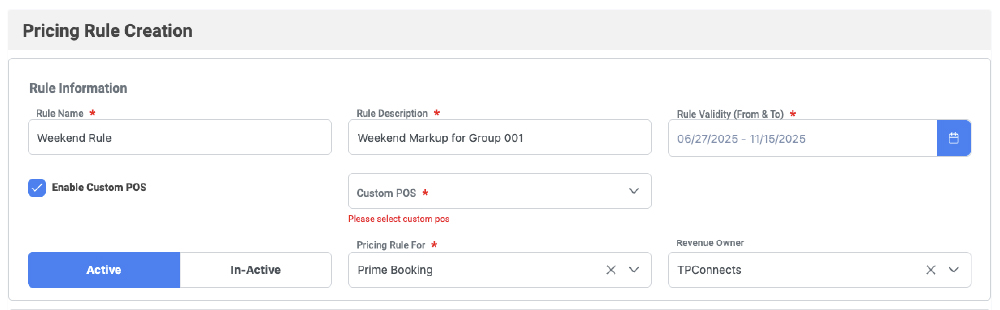
Instead of applying the same markup everywhere, a pricing engine lets you create rules like:
- Add +2% markup for bookings from Saudi Arabia during Ramadan.
- Add a fixed AED 10 fee on baggage for peak-season Dubai to Manila routes.
- Give a discount for ‘X’ agencies on specific fare types.
- Apply markup 20GBP for premium cabin bookings from the UK.
1. You set the rules , engine does the work automatically no spreadsheet uploads, no manual overrides, no risk of inconsistency.
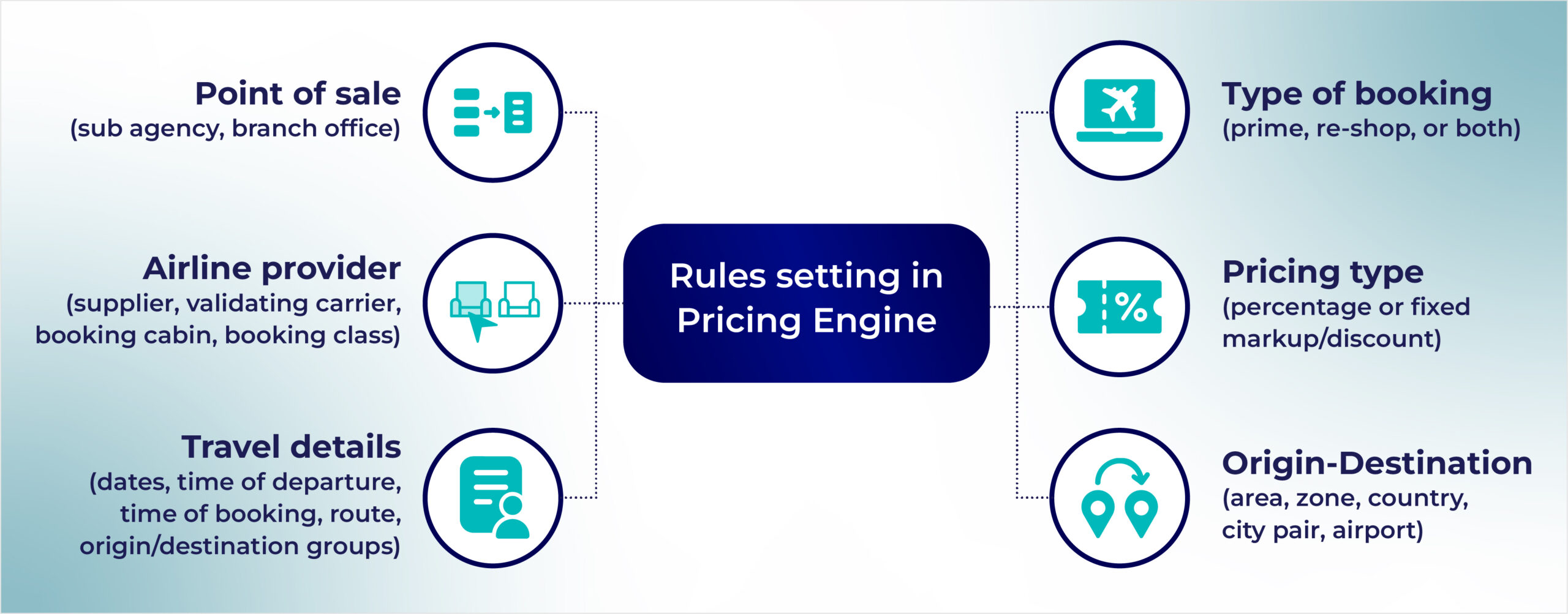
Rules can be set by:
- Point of sale (sub agency, branch office)
- Airline provider (supplier, validating carrier, booking cabin, booking class)
- Travel details (dates, time of departure, time of booking, route, origin/destination groups)
- Type of booking (prime, re-shop, or both)
- Pricing type (percentage or fixed markup/discount)
- Origin-Destination (area, zone, country, city pair, airport)
This ensures that your pricing reflects real market conditions not fixed, outdated formulas.
A major advantage for travel sellers is the ability to:
- Prioritize key airline partners
- Promote flights with higher incentives
- Boost carriers with special seasonal deals
- Increase sales for preferred NDC content
Your commercial agreements begin generating measurable financial returns.
3. Automate Tiered Markups and Promotional Pricing
With a pricing engine, you can instantly configure:
- Market-specific markups
- Route-tiered strategies
- Airline-based pricing rules
- Seasonal promos
- Tactical discounts
- High-demand vs low-demand route strategies
No repetitive manual updates. No delays. No inconsistencies.
4. Protect Margins with Min/Max Boundaries
Margin leakage is a major concern for high-volume agencies. A pricing engine lets you enforce:
- Minimum margins to avoid under-pricing
- Maximum caps to stay competitive
- Price markup adjustments during volatile periods
You stay profitable even on your highest-volume routes.
5. Gain Full Visibility Through Reporting
Agencies need clear insight to take informed business decisions. Pricing engine provides customized reports that show:
- Markups and discounts applied
- Revenue uplift by route
- Airline performance
- Market-level trends
- Seasonal variations
- Booking behaviour insights
This data helps you refine strategies and continuously improve results.
What Travel Sellers Can Achieve Today with a Pricing Engine
1. Point of Sale (subagency, branch office) Pricing
Not all agencies, or even subagencies within the same group, operate with the same margins, customer expectations, or competitive pressure. A branch office in Dubai may handle premium travellers, while a subagency in Sharjah or Dhaka might focus on budget-conscious leisure traffic.
With Iris, you can:
- Set different markups for specific subagencies, branch offices, or POS groups.
- Align pricing with each branch’s commercial strategy or negotiated targets.
- Localize pricing based on the actual behaviour of customers served by each agency location.
For example:
A travel seller headquartered in Dubai may apply aggressive, low-margin pricing for its main corporate branch, while adding a moderate markup for leisure-focused subagencies serving longtail markets. This ensures every part of the business operates with the right level of competitiveness – without needing separate systems or manual adjustments.
A. Seasonal and Event-Based Strategies
Seasonality is predictable and profitable. Examples:
- Increase baggage markup during school holidays when families travel.
- Create special seat-offer pricing during summer or Eid holidays.
- Offer promotions during off-peak months to stimulate demand.
Rules can be set with clear validity windows, so your pricing adjusts automatically.
B. Offer-Period and Booking-Window Rules
Want to run a 10-day offer? A weekend flash sale? A month-long campaign? A pricing engine lets you:
- Activate time-bound markup/discount campaigns.
- Target specific POS or agencies.
- Automatically switch pricing at the start and end dates, even at midnight.
No manual intervention needed.

The Revenue Opportunity: How Agencies Can Gain $60+ More Per Booking
A strong pricing strategy executed through a flexible and configurable pricing engine unlocks significant potential. Agencies combining strategy with the right technology regularly achieve:
- Consistent markup improvements
- Higher margins on strategic routes
- Better airline incentive earnings
- Optimized use of negotiated fares
- Faster deployment of profitable pricing strategies
When multiplied across thousands of monthly bookings, these gains create a massive revenue impact.
🚀 Ready to Grow Your Margins at Scale?
If your agency wants to maximize revenue potential, the right pricing engine will:
- Increase revenue per booking
- Automate complex pricing decisions
- Give you full control across markets
- Strengthen your airline relationships
- Protect profitability across all routes
A rule-based pricing engine is different:
- It’s deterministic.
- It applies your business-designed rules.
- It’s lighter, faster to deploy, and easier to control.
- It produces consistent, explainable outcomes.
Now is the time to modernize your pricing strategy and start unlocking the revenue your volumes truly deserve.
👉 Book a Strategy Session.
Learn how travel sellers are transforming their pricing to unlock massive revenue gains.