GBTA Middle East Event Recap: Navigating the Evolution of Corporate Travel in a Fragmented Ecosystem
February 20, 2026
Event Overview
The GBTA Middle East session brought together key stakeholders across the corporate travel ecosystem to address the mounting pressures travel managers face in 2026. With rising traveler expectations, expanding content sources, evolving technology, and shifting distribution models, the panel explored practical strategies for building resilient travel programs in an increasingly complex landscape.
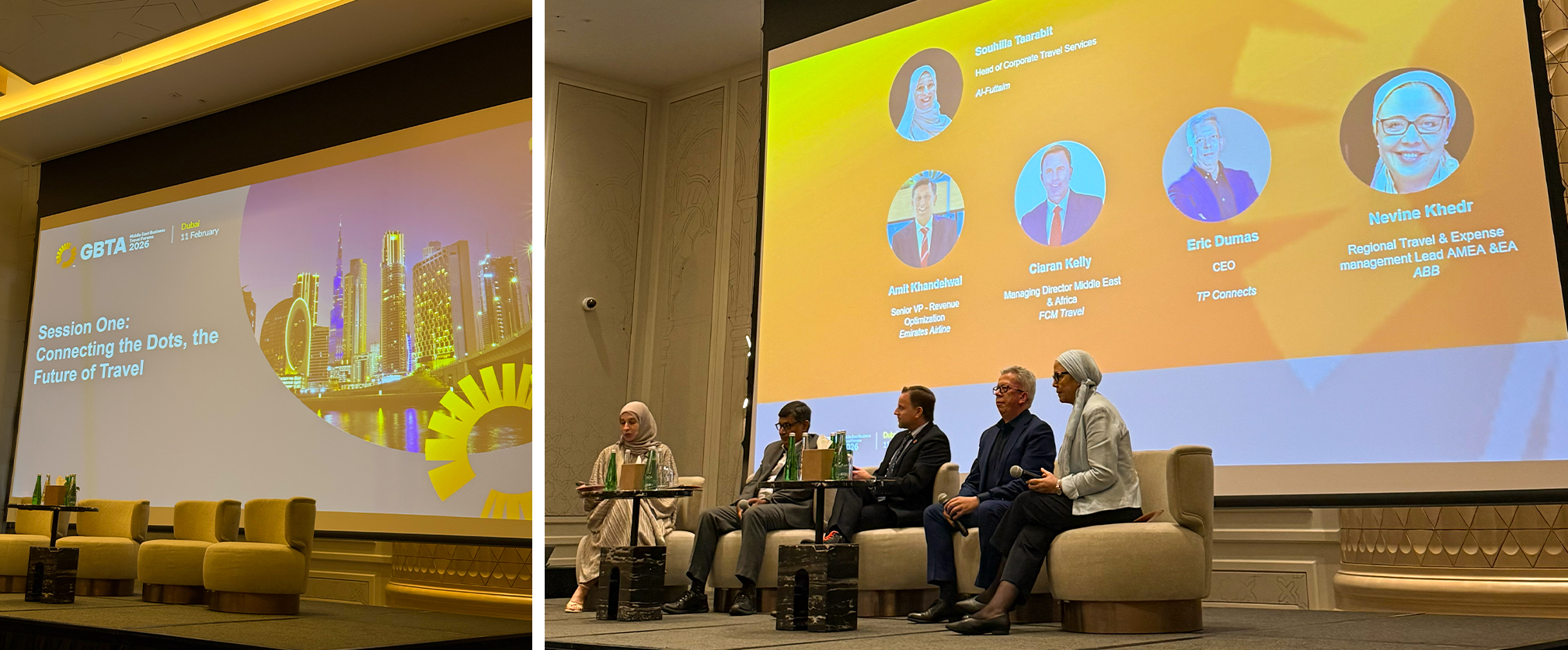
GBTA hosted its first Middle East event in Dubai, bringing together approximately 80 corporate travel stakeholders from across the region. The Middle East represents a unique and rapidly growing market, accounting for approximately 2.5% of global corporate travel volume. While this signals significant growth potential, the region faces distinct complexities, including rapidly changing policies, stringent visa regulations, and high-volume disruptions driven by geopolitical factors.
TPConnects participated in a panel discussion titled “Connecting the Dots, the Future of Travel” that brought together diverse perspectives from corporate buyers, TMCs, airlines, and technology providers to explore future-oriented strategic insights.
Key Discussion Themes
The Challenges Facing Corporate Travel Today
The corporate buyer perspective highlighted capacity constraints and pricing pressure driven by explosive regional growth, particularly between the UAE and Saudi Arabia. Last-minute booking behavior creates operational complexity, while limited planning windows make program management increasingly difficult.
From the TMC side, content fragmentation across NDC, GDS, and non-GDS channels creates visibility challenges. Add regulatory complexity around visas, withholding tax, and regional compliance, plus major disruptions requiring rapid response, and the role of TMCs becomes clear: “eating the complexity” to deliver smooth solutions for buyers.
Eric Dumas from TPConnects framed the technology challenge with a Formula 1 analogy: “Changing the engine while driving at 250 km/h.” While high demand and full planes signal robust business growth, systems designed in the 1980s struggle to support modern retailing needs. The Middle East is seeing record-high ticket changes due to geopolitical volatility, creating a servicing crisis that demands modern technology infrastructure.
Understanding NDC: Modern Airline Retailing
Following on the panel “Today you want to buy a book. You can go to Amazon, a bookshop, or other platforms. It’s not guaranteed you’ll get the same price. NDC promotes the same type of freedom of distribution for airline content.”
The core shift is from selling “seats” to selling complete travel experiences – ground transportation, flexible baggage, meal preferences, and journey merchandising. Airlines want multi-channel distribution freedom and dynamic pricing capability based on channel and context.
The numbers tell the adoption story: 70+ airlines have deployed NDC technology, 20%+ of tickets globally are now sold through NDC channels, and major European carriers are exceeding 50% NDC penetration, targeting 100%.
Leisure travel embraced NDC quickly due to clear price advantages and immediate merchandising benefits. Corporate adoption lagged due to 50 years of established processes, policy complexity, and the need for stakeholder education. But corporate adoption is now accelerating as airlines push retail transformation aggressively, TMCs and technology providers mature their solutions, and buyers recognize the value in product differentiation.
Content Differentiation: Creating Choice
From the airline perspective, content differentiation provides freedom on both sides: airlines control what content goes to which channels, while buyers access different products at different price points.
While differentiation creates operational complexity for TMCs and technology providers, it enables choice as a value proposition. Corporate travel managers can optimize based on policy, cost, and traveler preference, while TMCs can differentiate their offerings through curated content strategies.
Eric’s call to action for TMCs was direct:
“This content differentiation strategy is a way for you to bring different value to customers. It generates value for sellers. The future of your value proposition is in this price and product differentiation, where you give travelers a choice.”
The OBT (Online Booking Tool) Adoption Challenge
The session concluded by addressing the persistent challenge of OBT adoption in the Middle East region. Despite advances in technology and content availability, actual usage remains uneven – compounded by rapid policy changes, last-minute booking culture, and unique operational requirements. This remains an area requiring continued focus from technology providers and TMCs.
Emerging Trends Beyond the Panel
A dedicated AI panel explored how artificial intelligence is transforming corporate travel – from intelligent content aggregation and predictive analytics to automated servicing and personalized recommendations, with AI transitioning from innovation to essential infrastructure.
Conversations throughout the event revealed travel sellers exploring non-air ancillaries like eSIM services, travel insurance, and other products to diversify revenue streams beyond ticketing. There’s growing interest in OBT platforms, payment solutions, and content aggregation technologies. The recurring theme: travel sellers are exploring how to become holistic travel solution providers rather than pure ticketing intermediaries – particularly relevant in a developing market like the Middle East.
Key Takeaways
The Middle East offers explosive growth potential but comes with unique complexity. While the region represents just 2.5% of global corporate travel today, its rapid expansion signals a significant untapped opportunity.
NDC is reaching maturity after 15 years, with 20%+ global penetration signaling mainstream status. Corporate adoption is accelerating after leisure led the way, driven by airlines pushing retail transformation and buyers recognizing the value of product differentiation.
The fragmentation everyone fears can actually create value. Content differentiation equals choice for travelers, multiple channels create strategic sourcing opportunities, and complexity for suppliers becomes differentiation for TMCs.
Change management – not technology – is the real challenge. The technology exists; what’s needed is process evolution, transformation of 50 years of GDS-centric workflows, and stakeholder education across travel programs.
Success requires collaboration. Airlines, TMCs, technology providers, and buyers must work together, with TMCs playing the critical role for buyers while technology providers bridge legacy and modern systems. As Eric noted, it’s about “changing the engine mid-race” – transforming infrastructure while maintaining operations in a fast-moving market.
Want to learn how TPConnects Iris can streamline your multi-source servicing operations? Get in touch with our team