From Content Fragmentation to AI Adoption: How Travel Sellers Can Work Faster and Better
When travel sellers at the “From Content to Intelligence: Evolution of Travel Distribution” webinar were asked about their biggest challenge, the most common answer was not AI. It was the number of systems needed to sell a single trip: a GDS, separate NDC airline portals, and low-cost carrier websites, each with its own screens and steps. For sellers, that means more time spent moving between systems to answer a single request.
According to Skift State of Travel 2026, 63% of travelers have used AI to plan a trip, while only 2% of travel companies have scaled AI agents. Agencies still switching between systems struggle to match that speed, and the same fragmentation holds back their own use of AI. For travel sellers, adopting AI raises a practical question: how can an assistant deliver a useful answer when the content and actions it needs sit across separate systems?
This article draws on the webinar, held with ECTAA and Cruise Guru, to explain how unified content and servicing support AI adoption in travel selling. Cruise Guru, a Bulgarian consolidator serving more than 100 partner agencies and SME corporate customers, shared how it uses TPConnects Iris aggregator solution to manage growing volumes and reduce routine work, and how the use of AI continues to drive efficiency forward.
Before AI, there is still content fragmentation to be solved
Fragmentation affects both sides of the booking process. Accenture found that nearly two in three travelers use four or more platforms to book a single trip, and 94% describe the process as moderately or very complex. For travel sellers, working across separate systems adds time to comparing offers, applying pricing, and managing bookings.
An AI assistant needs reliable access to offers, fare rules, and the actions required to fulfil a request the same way a human agent does. If those sit across disconnected systems, the agency must account for different formats and workflows before it can automate the task reliably.
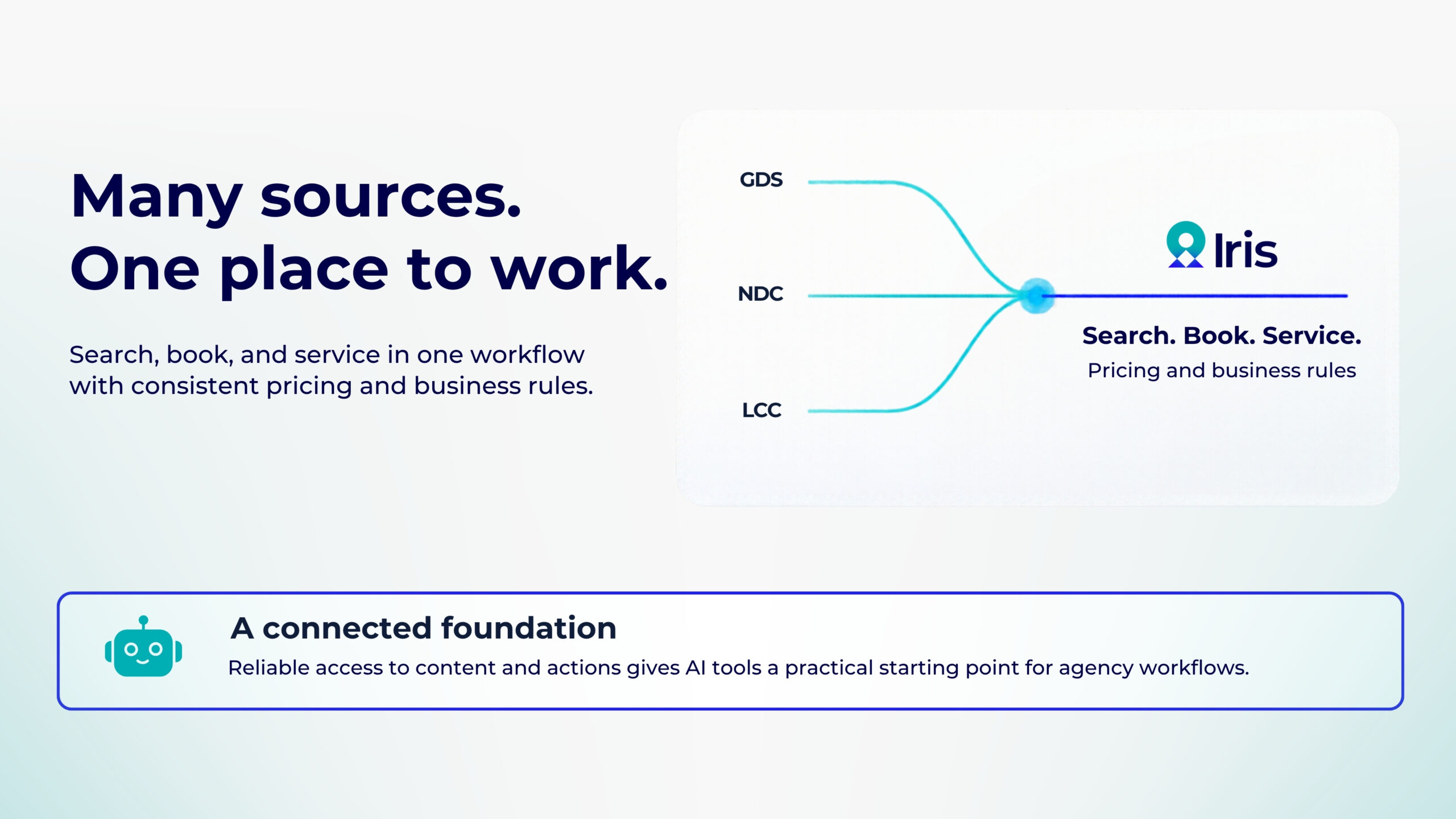
Before AI can act on airline content, that content has to be in one place. Iris provides that foundation through air content aggregation. It brings 65+ NDC and LCC connections and four GDSs into one platform, where sellers manage their own pricing, business rules, and content controls.
What Cruise Guru fixed before AI
For Cruise Guru, the foundation came before AI. As their booking volumes grew, the challenge shifted from finding content to managing the number of portals the team used. Their team needed one place to search and book, consistent application of its pricing, and a way for partner agencies to handle routine requests themselves. Iris brought those workflows together across GDS, NDC, and low-cost content.
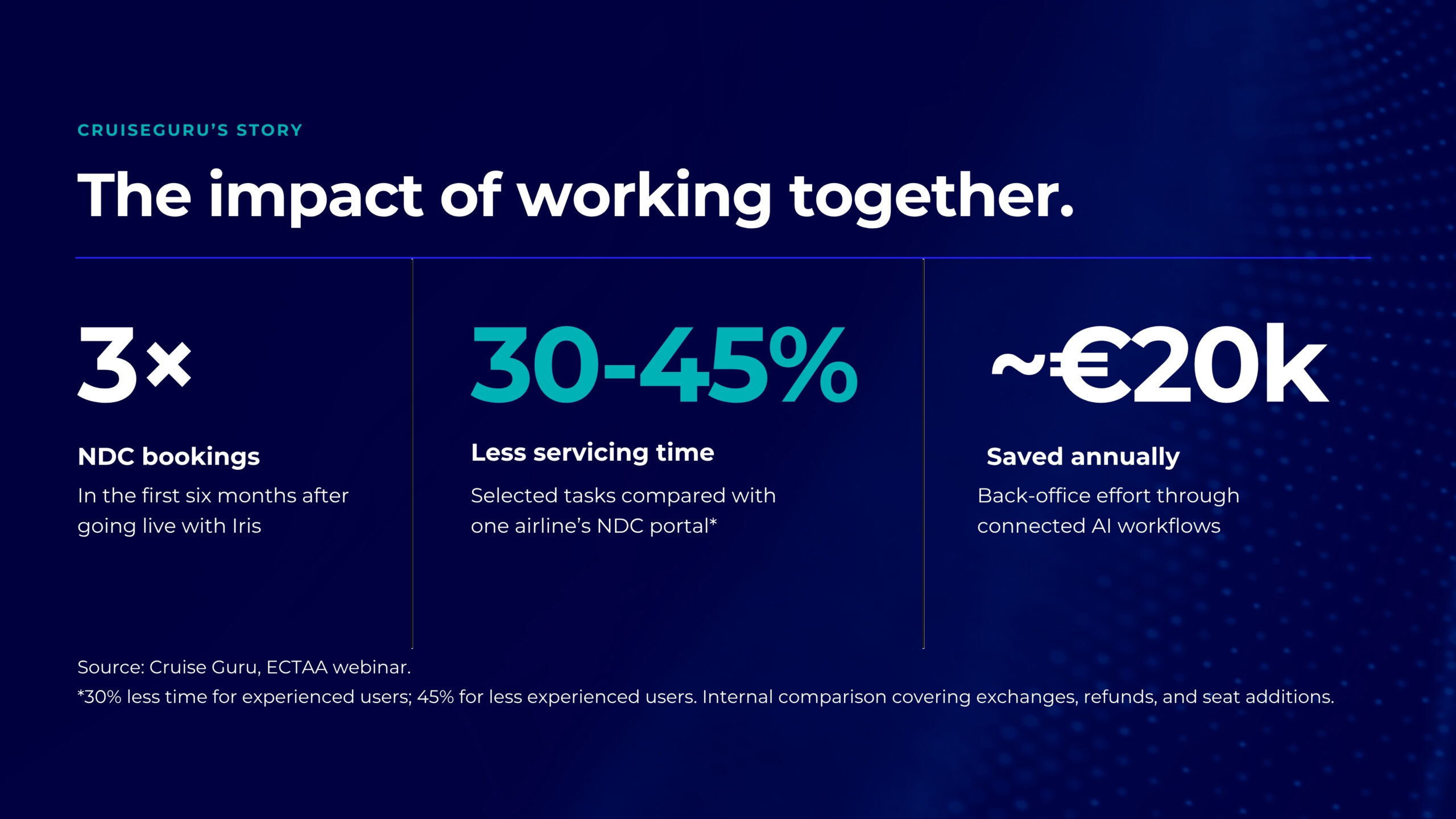
Cruise Guru tripled its NDC bookings in the first six months after going live with Iris.
But bringing content into one place is only the first step, the bigger challenge comes after the booking. Date changes, refunds, and reissues are where travel sellers lose the most time, and where AI agents are most likely to get stuck. That is why Iris handles booking servicing in the same platform, from cancellations and refunds to reissues and disruption management. That removes the waiting between people as well as between systems. For Cruise Guru, an internal comparison of exchanges, refunds, and seat additions against one major airline’s NDC portal found that experienced users completed tasks 30% faster on Iris, while less experienced users took 45% less time.
What AI does once the foundation is in place
With all that set, AI has a reliable foundation to work from. For Cruise Guru, the first gains came in work customers never see. Its AI agents import tickets from Iris into the CRM, match each one to the right agency and booking, and reconcile incoming payments and BSP reports. Together, that saves around €20,000 a year in back-office effort.
For a smaller agency, the day often starts with a morning inbox of simple fare requests that must be cleared before the more complex ones get attention. AI can handle this, giving the team more space for their business to grow.
Large travel companies are seeing the same pattern. A major online travel group, Skift reports, has been handling more bookings with AI while spending less to service each one: volumes rose 10% while service cost per booking fell by the same margin.
On the sales side, the line is drawn differently. Simple, point-to-point flight requests are now handled largely by AI. But when an itinerary gets complex, or a customer needs real advice, the travel advisor takes the lead, with AI included but not in charge.
“Very often the valuable part is knowing what to ask the customer before you even start searching, and that’s still the human strength.” Nikola Nikolov, CEO of Cruise Guru, shared a concrete example: a simple request came in – point-to-point flights, two dates, one traveler. His AI assistant, connected to his email, CRM, and the Iris solution, didn’t just suggest an answer, it drafted and sent a fully priced, well-written reply to the customer, including fare options.
However, experienced travel advisors still remain essential for complex itineraries, groups, disruptions, and understanding what a customer needs before the search begins. Automating routine work gives them more time for those conversations and decisions.
Onboarding AI agents with clear roles and limits
Travelers are open to AI for help, but not to hand over the whole booking. In Accenture’s survey, 40% would let an AI agent compare options entirely, while only 10% would let it make the payment. Skift’s research points the same way: travelers’ net comfort with booking through an AI chatbot is negative (-7%), while booking through a travel agent scores +34%. An agency can use AI to prepare options quickly while keeping a person responsible for reviewing the offer and confirming the next action.
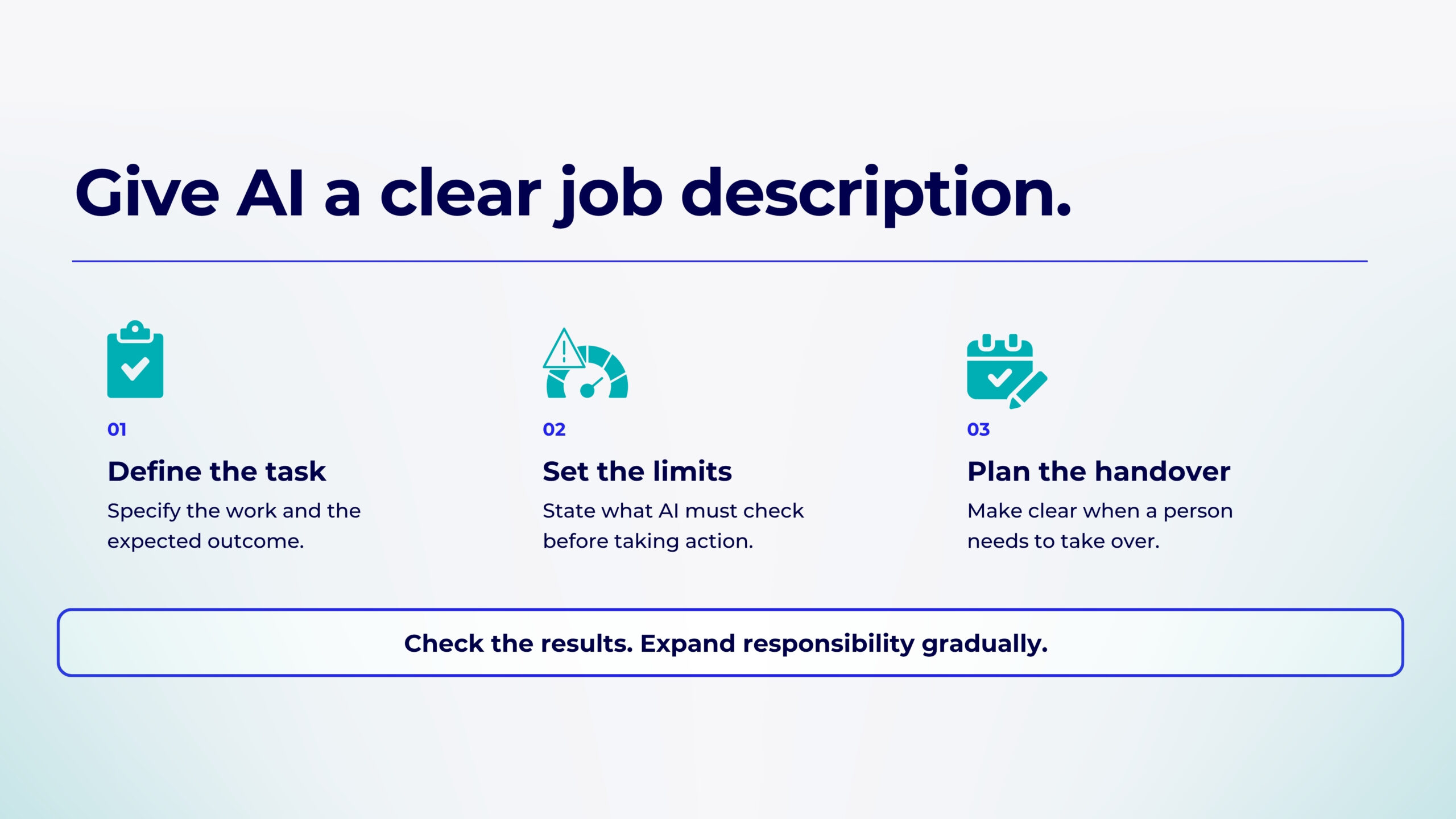
As Nikola put it, “the gap isn’t the technology, it’s the job description.” An AI agent needs clear instructions on what it can do, what it must check, and when to ask a person. Matching payments is one example: the correct amount alone does not prove that a payment belongs to a particular booking. CruiseGuru’s approach is to start with a limited task, check the results, and expand responsibility gradually.
Connecting AI tools to airline content
Many travel sellers are already experimenting with AI assistants such as Claude or ChatGPT. What limits them is not the assistant, but what it can reach. An AI tool that can only see one portal at a time gives the same partial picture a human agent would.
The Iris API and MCP layer connect airline content and servicing capabilities to the tools travel sellers build or already use. The API supports integrations with agency applications and workflows, while MCP allows compatible AI assistants to interact with Iris through a common protocol. Together, they give sellers a foundation for searching and comparing offers, preparing quotes, and automating booking and servicing tasks, with the agency’s pricing, business rules, and approval requirements guiding the process.
Three moves for the period ahead
Automating everything at once can add more complexity and disrupt established processes. Agencies get more value from AI by choosing the right tasks and automating them in the right order. Here are three steps to bring fragmented content together and put AI to work.
- Consolidate: Count how many systems your team uses to search, book, and service flights. Bring those workflows together, with consistent pricing and business rules.
- Automate the routine: AI pays back first on quotes, simple bookings, servicing, invoicing, and reconciliation.
- Keep people on the complex: Travel agents are key when disruptions, groups, multi-stop itineraries, and customer relationships matter most.
- Cruise Guru’s experience gives travel sellers a practical starting point: reduce the effort involved in everyday bookings and servicing with aggregator solutions, then use connected AI tools to take on specific tasks to serve customers and grow without routine work increasing at the same pace.
Resources:
Book an Iris demo to see how Iris brings your airline content, servicing, and AI tools together in one place.