The End of Fragmented Product Management: How Unified OOSD Product Catalogue and Stock Keeper Are Redefining Airline Retailing
Airlines have struggled to become efficient retailers in the modern digital world as their products remain scattered across their existing systems – flights managed separately from ancillaries, which doesn’t allow for any unified view or control. IATA’s OOSD framework changes this with two critical components: Product Catalogue that defines all products in one place, and Stock Keeper that manages stock in real-time across all channels. Together, they give airlines what every retailer needs: full control over their product portfolio and how it reaches the market.
Key takeaways:
- Fragmented systems limited digital retailing capabilities – Flights and ancillaries in separate systems with no unified control
- One catalogue for all products – Flights, ancillaries, and third-party products all defined in a centralized location, enhancing bundling and distribution strategy
- Stock Keeper controls distribution – Real-time stock with channel-specific allocation
- Faster speed to market for new products with previously unsupported scenarios now unlocked – Mixed cabins, large groups, premium products
- Foundation for OOSD – All capabilities depend on unified products and stock management
The decades-old separation between flights and ancillaries is finally over. Here’s why it matters:
For decades, airlines have operated with a fundamental problem: their core product – the flight – lived in one system (the RBD), while ancillaries lived in another. Bundles required complex mapping between the two. Third-party content? Yet another integration.
This wasn’t just inconvenient. It made efficient digital airline retailing impossible. That’s changing. With IATA’s OOSD framework maturing, unified product catalogues are finally giving airlines what other retailers have had for years: one place to define all products, create any combination, and deliver personalized offers.
The Legacy Problem: Half Your Products Were Invisible
Legacy catalogues only covered ancillaries. Seats, bags, meals, lounge access – these lived in product catalogues, but flights themselves were managed in reservation databases with booking classes, fare families, and rigid legacy structures.
The consequences were severe. Airlines had no unified view of what they actually sold, and inflexible bundling remained constrained by booking classes. Separate systems managed flights versus everything else, creating multiple “sources of truth” for products. Complex integrations were required for every channel, limiting personalization capabilities and providing no real-time visibility into what inventory was actually available.
When NDC promised rich content and dynamic offers, airlines discovered their real obstacle: they couldn’t actually define and combine products the way modern retailing required. Worse, they couldn’t manage stock across these fragmented systems.
The Breakthrough: One Catalogue for Everything
Modern OOSD-focused product catalogues establish a single source of truth for all airline products.
How It Works
- Everything is a product: A London-New York flight is a product. Priority boarding is a product. A bundle combining both with lounge access? Also a product. Making everything simple to create, manage, and easy to bundle, while having full control over distribution strategies across all channels.
- No more RBD dependency: Product definitions are independent of legacy structures. Airlines can think like retailers, not inventory managers constrained by booking class logic.
- Dynamic combination: With all products in one catalogue, offer engines seamlessly combine any mix. Flights, ancillaries and third-party content – all from the same source.
- Single integration: Every channel – NDC, direct booking, agencies, corporate tools – pulls offers from one catalogue. One product model. One set of APIs.
Built on Standards, Designed for Flexibility
Leading implementations align with IATA APMWG best practices while using modern technology. Core capabilities include IATA Airline Taxonomy compliance and schedule integration via existing standards like SSIM/SSM/ASM or through OAG and Cirrium, delivered through modular JSON APIs rather than rigid legacy protocols. Advanced flight schedule management works alongside master location and aircraft data management, supporting both single and multiple retailer catalogues. The system also integrates supplier catalogues for third-party content, creating a truly comprehensive product foundation.
The Missing Piece: Real-Time Stock Management
But defining products is only half the equation. Airlines need to know what’s available to sell – in real-time, across all channels. This is where the Stock Keeper component becomes critical. Working hand-in-hand with the product catalogue, modern stock management systems provide the operational control that makes dynamic retailing possible.
Real-time Stock Management
The system tracks flight seat and ancillary stock, managing bundle stock for packaged offerings while providing instant visibility into availability across the entire product portfolio. Revenue management teams gain clarity into what’s sellable at any given moment while operational staff use the same visibility for service delivery, upselling, and resource allocation.
Channel-Specific Control
Airlines can now control allocation by channel, offering different inventory to different distribution partners. Block stock for specific channels, retailers, or corporate customers becomes straightforward, with stock block release periods managed through automated timing controls. This prevents channel conflict and enables truly strategic distribution – no more accidentally selling premium stock through discount channels.
Operational Visibility
Ground staff and operations teams gain real-time visibility into ancillary stock – how many extra bags can be sold at check-in, meal selections still available, or wheelchair types that can be accommodated in the cargo hold. This ensures smooth service delivery and prevents overselling operational resources.
Technical Flexibility
Flexible JSON APIs align with modern architecture while providing legacy system support during the transition phase – such as existing inventory feeds, accommodating AVS/NAVS bucking concepts, or ATPCO feeds – ensuring seamless integration with both new and existing systems. Airlines can start modernizing and gaining benefits before replacing all systems. Together, the Product Catalogue and Stock Keeper create a complete retail foundation: you define what you sell, and you control how much is available to whom, when, and through which channels.
Spotlight on Transition: ATPCO Integration
The industry accepts that the move to OOSD cannot be a “big-bang” cutover for airlines, and they cannot abandon the existing structures overnight. While transitioning to OOSD capabilities, the industry will still run on existing legacy capabilities like Filed and Branded Fares via ATPCO.
Leading Product Catalogue implementations must include automatic ATPCO synchronization for new features like ATPCO’s Product Catalogue, which enhances Branded Fares capabilities or existing features like ATPCO Fare Feeds. Vendors will be responsible for ensuring business continuity for airlines by translating these crucial legacy components into the modern OOSD formats – enabling seamless bidirectional data flow between the OOSD catalogue and ATPCO system.
ATPCO integration enables transformation without risk, allowing airlines to move to OOSD at a pace that suits their business.
Read more about the latest airline advancements
Three Fundamental Transformations
1. Unified Product Management
Before: Silos everywhere
Revenue management owns fares. The ancillary team manages extras separately. Bundles require complex mapping. New products take months to launch.
After: One catalogue, with improved collaboration across teams
All products are defined consistently. Combined based on business rules, no system limitations. Cross-functional teams work from the same model. New products are launched in weeks.
Results: Product launches in weeks that would have taken months before.
2. True Retailing Flexibility
The old constraint: Booking classes forced everything into predefined buckets. Want to offer free changes for bookings made 6+ months in advance? Include premium seats for early bookers without creating a new fare family? Not possible.
The new reality: Airlines can personalize across multiple dimensions – loyalty status, route, season, purchase timing – without being constrained by booking class logic. Dynamic bundling based on customer context becomes standard. A/B testing of different combinations requires no system changes, and variations are unlimited if you can define the business rule. Real-time stock adjustments respond to demand patterns and channel performance, optimizing revenue across the network.
3. Full Catalogue and Stock Control
Airlines gain rich media content management for images, videos, and descriptions directly in the catalogue. Product versioning and lifecycle management become straightforward. Real-time stock allocation flows to distribution channels based on strategic priorities, with stock blocking capabilities for premium partners or campaigns. Vendor lock-in has dramatically reduced, product launches that once took quarters now take days, and airlines can test and implement changes quickly without complex pre-work or lengthy testing cycles.
Airlines can finally define products the way they want to sell them, and control precisely how inventory flows to market – not how legacy systems force them to be structured.
What This Looks Like in Practice
Scenario 1: Mixed Personal and Business Travel
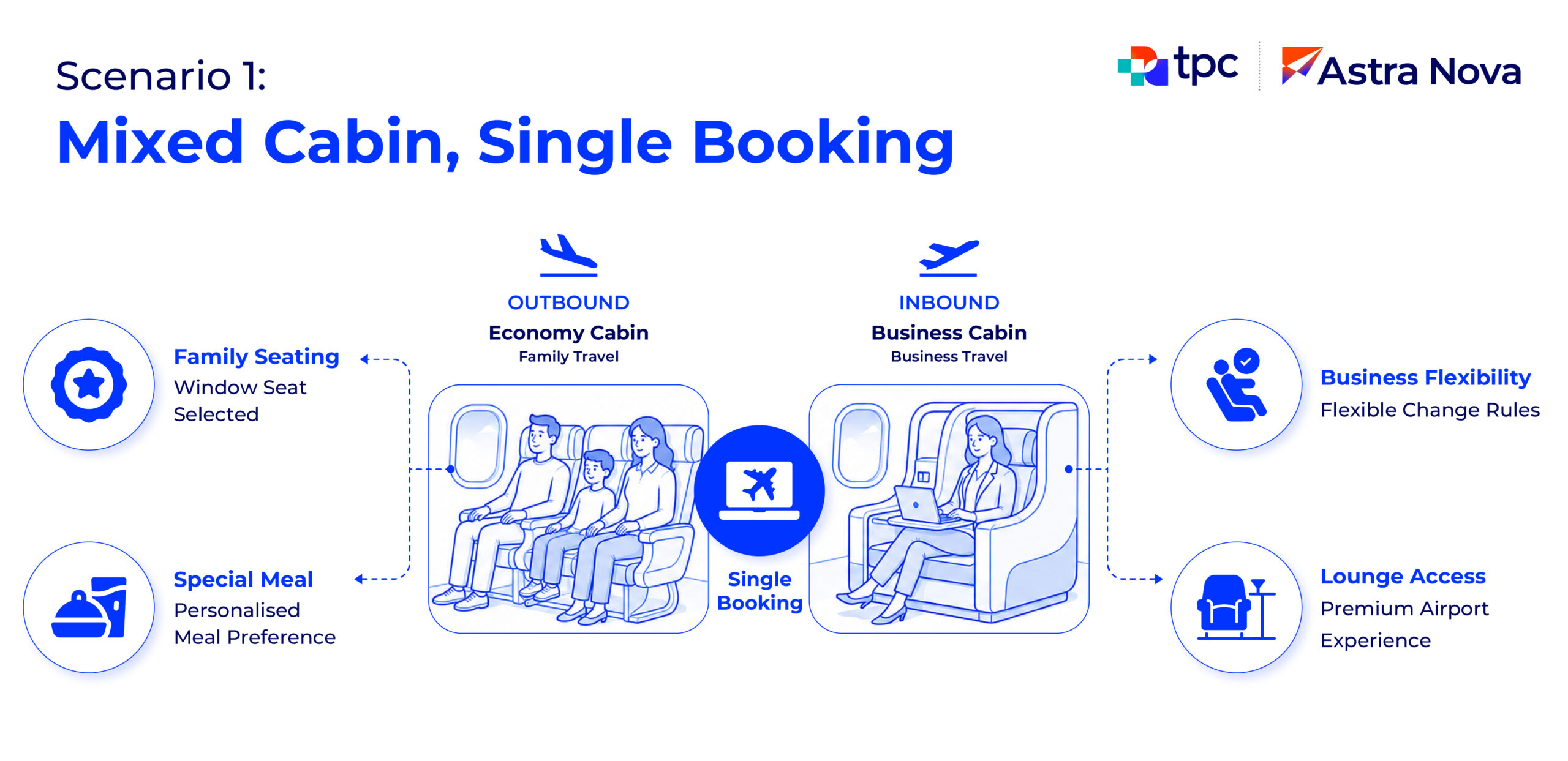
A passenger books standard economy outbound with family (window seat, special meal) and flexible business class return from a conference – different cabins, bundled ancillaries, flexible rules, all in a single transaction.
How OOSD handles it:
Product Catalogue defines the mixed-cabin journey as a single product. Offer Management bundles ancillaries intelligently – window seat and special meal for the outbound economy leg, lounge access and flexibility for the business class return. Order Management handles the booking as one transaction with different service rules per segment including different change and refund policies per segment. When the conference dates shift, Order Accounting processes the flexible change automatically while maintaining the family’s outbound arrangements.
Legacy system reality: Separate PNRs for different cabins, manual coordination of ancillaries, complex rebooking that risks losing seat assignments, ancillary re-attachment problems and having to enforce the most restrictive rules across the entire journey even if more flexible products were included.
Scenario 2: Large-Party Booking
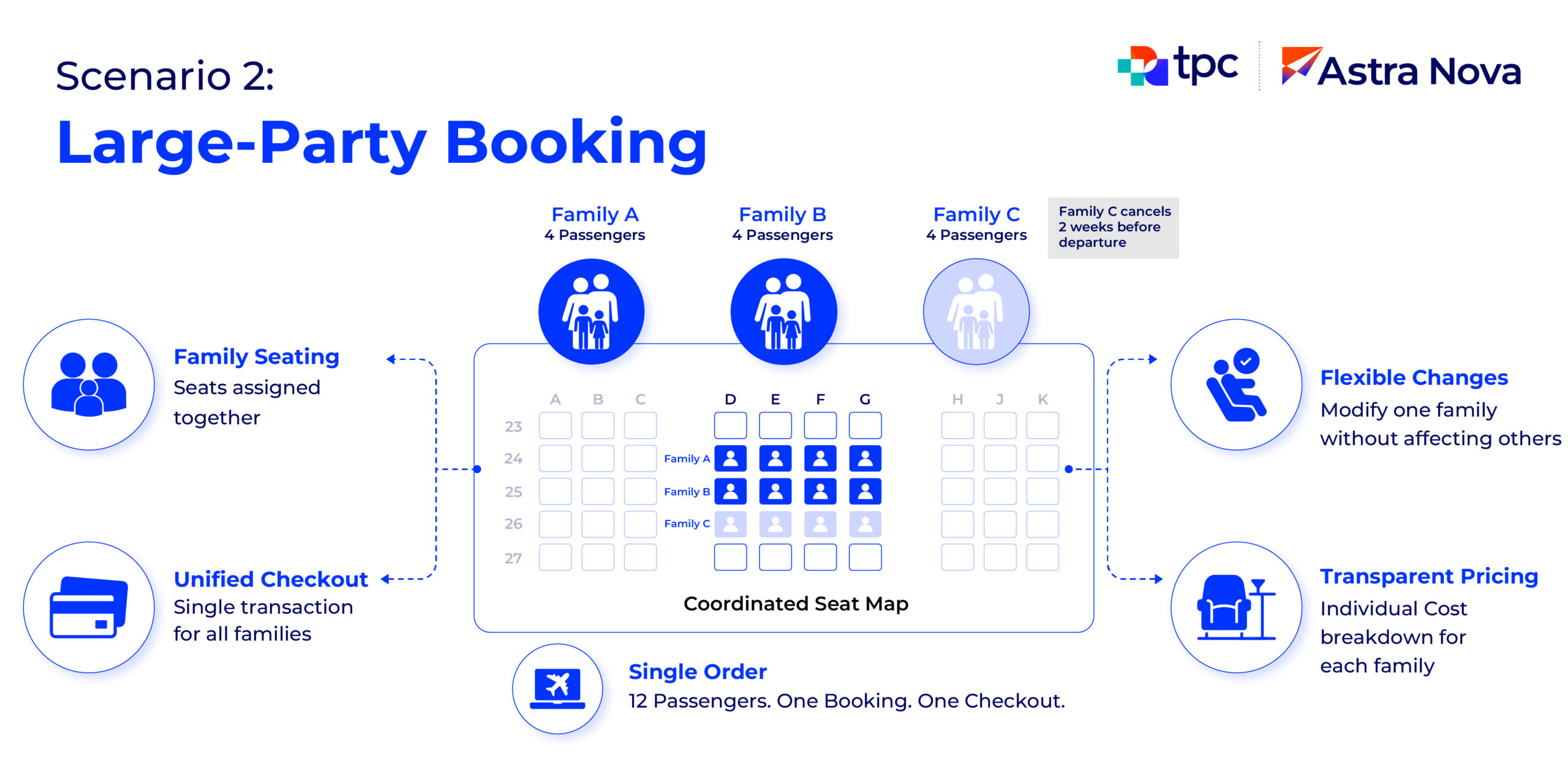
Three families traveling together – 12 passengers total – need coordinated seating, unified checkout, and transparent pricing without hitting legacy 9-passenger limits which traditionally forces these larger groups into the group booking processes even if an airline would not like to consider them under this definition.
How OOSD handles it:
Stock Keeper allocates 12 seats across three families without passenger count restrictions. Offer Management presents coordinated seat maps showing all three families’ positions and transparent pricing with individual breakdowns. When one family cancels two weeks before departure, Order Management services the change at the family level while maintaining the other bookings. Order Accounting recalculates and posts refunds in real-time, adjusting pricing for the remaining families if applicable.
Legacy system reality: Technically possible through multi-step processes, but operationally rigid – PNRs larger than 9-passengers automatically considered groups, require manual seat coordination, and include an inflexible change process. Whether an airline wants to reprice all travellers or handle changes individually, legacy systems require complex manual intervention rather than a configurable and streamlined process utilizing business rules.
Scenario 3: Premium Privacy Products
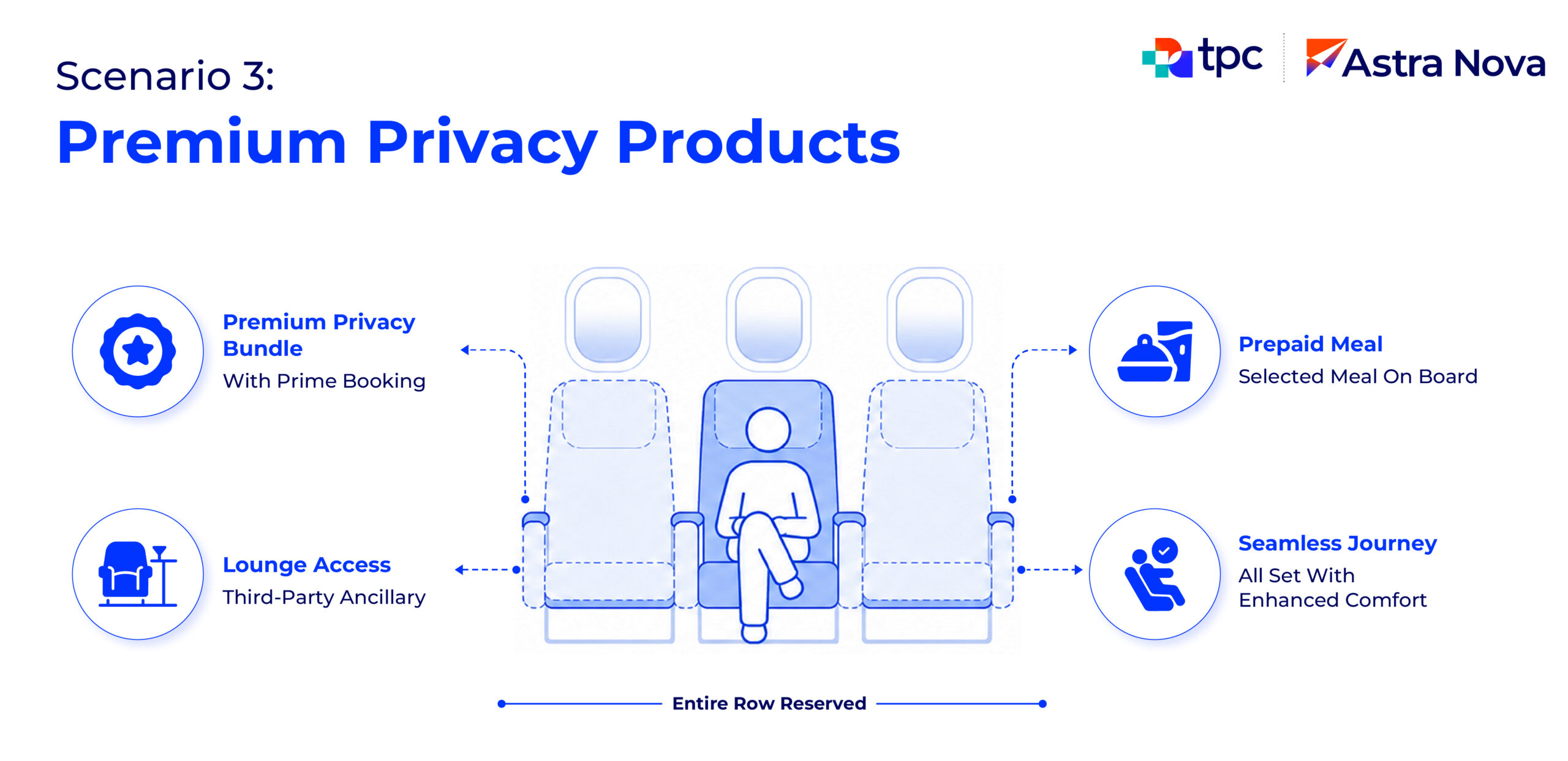
A single passenger purchases an entire row (three seats) for comfort and privacy on a long-haul flight – treating seats as a premium product, not just inventory.
How OOSD handles it:
Product Catalogue defines “Privacy Row” as a premium comfort product with rich descriptions and imagery. Stock Keeper allocates three seats to one passenger record, removing them from general sale. Offer Management enables flexible pricing strategies – airlines can position it as a premium option, or adjust pricing based on cabin performance and competitive needs. Order Management treats it as a single order item through check-in, boarding, and the entire travel lifecycle.
Legacy system reality: Requires complex manual workarounds and coordination across multiple systems. Manual seat blocking, custom pricing, multi-system coordination, and separate revenue tracking. Technically possible but operationally cumbersome and error-prone. These aren’t theoretical. They’re scenarios travellers expect, and competitors in other industries deliver routinely. Airlines with OOSD capabilities can meet these expectations. Airlines without them cannot, regardless of how sophisticated their NDC implementation may be.
Unlock new revenue opportunities with a data-driven look-to-book approach
Why It Matters for OOSD
The Product Catalogue and Stock Keeper sit at the heart of IATA’s framework. Offers combine products into personalized propositions with real-time availability. Selected products become orders with stock committed. Financial settlement references product definitions and consumed stock. Products are fulfilled to customers with stock reconciliation, completing the loop.
The reality is simple: you cannot do dynamic offers without a unified product catalogue, and you cannot deliver those offers reliably without real-time stock management – together, they are the foundation everything builds on.
The Bottom Line
For years, airlines talked about “becoming retailers” while operating fragmented systems that made retailing impossible.
Unified OOSD product catalogues and real-time stock management finally remove that constraint. Airlines can now define, manage, and merchandise their complete product portfolio like actual retailers – with full control over what’s available, to whom, and through which channels.
This isn’t just a technology upgrade. It’s the foundation that makes retail transformation real.
The era of true airline retailing has begun.
TPConnects Astra Nova delivers open, modular and legacy-free OOSD capabilities, including a smart bridge for a phased risk-free transition.
Contact us: sales@tpconnects.com | tpconnects.com